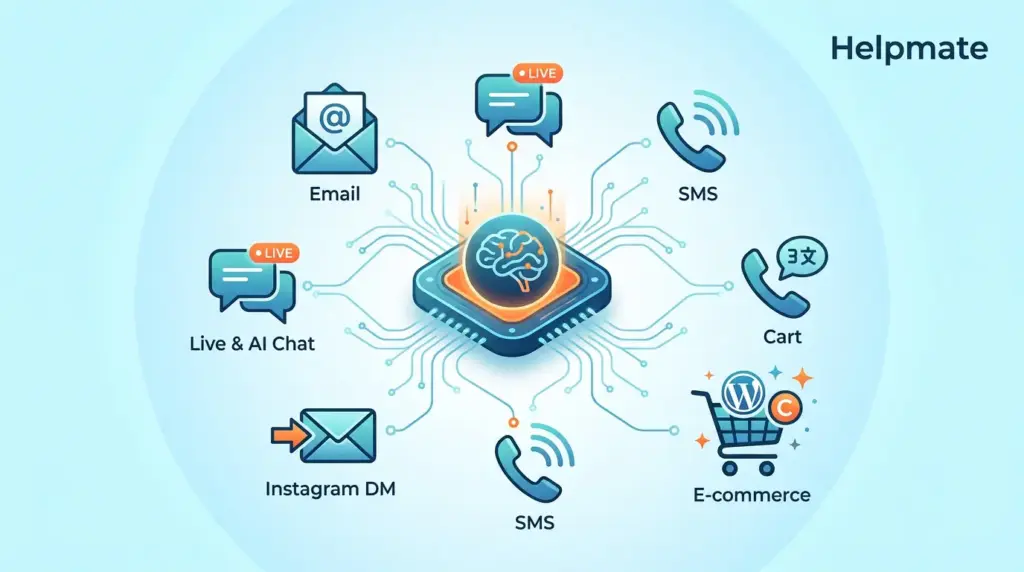
Omnichannel marketing automation is basically about keeping conversations going—whether someone slides into your DMs, shoots an email, or pops up on live chat. The system remembers what they said last time and picks up where you left off without anyone having to copy-paste notes between tabs.
Key Takeaways
- Omnichannel shoppers spend 1.7 times more than single-channel shoppers (McKinsey, 2022)
- Companies with strong omnichannel engagement retain 89% of customers versus 33% for weak programs (Deloitte, 2025)
- Marketing automation saves teams 3.6 hours per week on average (Salesforce, 2023)
- True omnichannel requires unified data, not just multiple channels
- WordPress sites can implement this through integrated chatbot and CRM solutions
Thinking about setting this up on your WordPress site? Here’s how Helpmate’s omnichannel marketing AI actually pulls every customer touchpoint into one place without the usual integration headaches.
Here’s the thing—customers don’t wake up thinking “I should engage with this brand via email today.” They just have problems they want solved. I remember talking to a store owner back in January who was dumping money into Facebook ads while his support inbox sat overflowing. Same story everywhere: teams treating each channel like its own little kingdom, wondering why people keep falling through the cracks.
The teams getting it right are connecting the dots. Not in some abstract strategic way—literally connecting the data so when someone abandons a cart on mobile at lunch, they don’t get treated like a stranger when they email at midnight. The numbers back this up hard. Organizations pulling this off are seeing serious jumps in lifetime value and retention. But most businesses still think omnichannel means “we have an Instagram AND a newsletter,” which misses the point entirely.
What Is Omnichannel Marketing Automation, Actually?
At its core, omnichannel marketing automation is just tech doing the remembering for you. 80% of customers say the experience matters as much as the actual product (Salesforce, 2022). That stat hits different when you think about the last time you rage-quit a purchase because a website made you fill out the same form twice.
Real omnichannel automation means your website, social DMs, email platform, and chat widget all share the same brain. Customer abandons a cart? The system flags it. Three hours later they message your Facebook page asking about shipping? The agent—or bot—knows exactly what they were looking at. No “can you confirm your order number” dance.
The thing that separates this from just being everywhere is that data actually syncs. One profile, constantly updating. Not your email team blasting promotions while your chat team handles complaints about those same promotions. The automation watches behavior—what they click, what they ignore, what they bought last month—and figures out what to say next without someone on your team manually connecting the dots.
How It Actually Works Under the Hood
There are four pieces that have to talk to each other: data collection, customer profiling, trigger logic, and the actual sending part. Marketing automation saves roughly 3.6 hours per week per person—about 23 working days annually (Salesforce, 2023). That time comes from killing the manual handoffs that eat up mornings.
Data collection happens everywhere. Website visits, Instagram comments, email opens, chat transcripts, purchase records—all of it feeds in through APIs and integrations. Your WooCommerce store, your CRM, your social accounts, your helpdesk. If they’re not connected, you’ve got expensive islands of information.
Then there’s identity resolution. This is the unglamorous tech that recognizes the same person whether they’re on their phone during commute or their laptop after dinner. They message your Facebook page Tuesday, email support Wednesday—the system knows it’s one conversation. Without this, you’re just guessing.
Trigger logic is where the automation gets interesting. Rules like: customer views the same product three times without buying, send a personalized email. They open it but don’t click within 48 hours, follow up with SMS. They reply to your Instagram story asking about sizing, tag them for the nurture sequence about fit guides. These workflows just run. No one has to remember to check.
Omnichannel vs. Multichannel—There’s a Difference
Multichannel means showing up everywhere. Omnichannel means those places actually work together. 70% of consumers expect consistency when they switch channels, but 60% run into conflicting messages or having to repeat themselves (Salesforce, 2022). That’s the multichannel trap.
I’ve seen teams where the email person never talks to the social media person. Each channel gets optimized in isolation. Your website analytics don’t talk to your SMS platform. Chat agents can’t see that this customer already got three promotional emails this week. Everyone’s doing their best, but the customer experiences fragmentation.
Omnichannel breaks down those walls. Data flows between systems. A conversation started in Instagram DMs continues via email without the customer re-explaining their issue. A discount code mentioned in chat automatically works at checkout. Abandoned cart emails reference the specific items they stared at on their tablet yesterday.
| Multichannel Approach | Omnichannel Approach |
|---|---|
| Channels exist independently | Channels are fully integrated |
| Data siloed by platform | Unified customer profile |
| Generic messaging | Behavior-triggered personalization |
| Manual handoffs between teams | Automated workflow continuity |
| Channel-centric metrics | Customer journey analytics |
Why This Actually Moves the Needle on Retention
Omnichannel customers are worth more. Full stop. Shoppers engaging across multiple channels spend 1.7 times more than single-channel shoppers (McKinsey, 2022). That’s not a rounding error—that’s the difference between a sustainable business and one constantly churning through new acquisition.
The retention gap is even wilder. Companies doing omnichannel well keep 89% of their customers year over year. Companies doing it badly? 33% (Deloitte, 2025). That 56-point spread is the difference between compound growth and constantly refilling a leaky bucket.
What makes it work is the consistency. When someone gets relevant messaging at the right moment—whether that’s email, chat, or SMS—they stop seeing you as a random vendor and start trusting you as “their” store. When they have to explain their problem three times or get conflicting offers, that trust evaporates. The automation handles the continuity so your team doesn’t have to memorize customer histories.
Recovery sequences show this in action. Abandoned cart emails with product images and personalized recs recover 10-15% of sales that would otherwise disappear. Layer in chatbot follow-ups or SMS nudges based on whether they opened the email, and those numbers climb. Nothing falls through the cracks because the system doesn’t get busy or forget to check.
The Five Pieces You Actually Need
Effective omnichannel automation stands on five things: a unified data platform, identity resolution that actually works, a trigger engine, personalization that doesn’t feel creepy, and a unified inbox so humans can jump in without context-switching. Organizations that get this right see about 23% higher satisfaction scores (Aberdeen Group).
Unified Customer Data Platform: One place where interaction history, purchases, preferences, and behavior signals live. Queryable. Accessible. Without this central brain, your channels are just shouting into the void.
Cross-Channel Identity Resolution: The tech that links email addresses to social handles to device IDs to phone numbers. Same person, recognized everywhere. This is the foundation everything else builds on.
Behavioral Trigger Engine: Rules and sometimes machine learning that watches what people do and decides what happens next. Time delays, action sequences, predictive scoring—whatever moves the conversation forward.
Content Personalization System: Dynamic assembly of messages using what you know about someone. Product recommendations, subject lines, buttons that change based on their profile. Not just “Hi [First Name].”
Unified Inbox: One screen where your team sees conversations from any channel. When automation hands off to a human, that human sees the full history. No “let me look that up for you” delays.
Getting This Running on WordPress (Without the Enterprise Budget)
WordPress sites can absolutely do omnichannel marketing automation. You don’t need a six-figure Salesforce implementation. Integrated plugins can handle chatbot functionality, CRM basics, and multi-channel messaging without duct-taping five different SaaS tools together.
Helpmate – Live, Social & AI Chat with Built-in CRM handles this unified infrastructure specifically for WordPress. Implementation starts with connecting your touchpoints: website chat, Facebook Messenger, Instagram DMs, WhatsApp Business, your email service. Each channel pumps conversation data into a shared CRM where profiles get smarter over time.
Then you set up workflows based on actions. Abandoned carts in WooCommerce trigger sequences. Lead capture forms start nurture campaigns. Social interactions update segmentation automatically.
The knowledge base piece trains AI on your existing content—product descriptions, blog posts, FAQs—so automated responses actually sound like you. When a human needs to take over, they see the full conversation history, not just “new ticket from unknown.”
Email campaigns, coupon delivery, proactive recommendations—all of it connects to your e-commerce and membership systems natively. Data stays in your environment. No exporting CSVs between platforms.
If you’re tired of customers getting lost between channels, get started with Helpmate and see what unified actually feels like.
Omnichannel means your channels actually talk to each other. Around 60% of consumers hit inconsistent messaging when switching between touchpoints (Salesforce, 2022)—that’s what happens when your email platform and chat system don’t share data. True omnichannel is one continuous conversation. Customer doesn’t have to repeat their story because the system already knows.
Marketing automation saves roughly 3.6 hours per week per employee—about 23 working days annually (Salesforce, 2023). That time comes from killing manual tasks: copying customer info between systems, sending individual follow-ups, compiling reports from three different dashboards. For a five-person team, that’s nearly 1,000 hours back per year. That’s time you can spend on strategy instead of copy-paste work.
Yes. McKinsey research from 2022 shows omnichannel shoppers spend 1.7 times more than single-channel shoppers. They’re also more likely to come back and recommend you to other people. The convenience factor drives both frequency and order size. When it’s easy to buy—whether that’s on Instagram, email, or your website—people buy more.
Organizations with strong omnichannel engagement retain 89% of customers annually. Compare that to 33% for companies with weak cross-channel programs (Deloitte, 2025). That 56-point gap is massive. It compounds over time too—higher retention means higher lifetime value, which means you can spend more to acquire customers while still being profitable.
Yes. Modern WordPress plugins give you enterprise-grade omnichannel without the enterprise price tag. Solutions like Helpmate combine chatbot, CRM, email automation, and social messaging in one tool. You’re not paying for five separate SaaS subscriptions plus integration middleware. The total cost often drops because everything’s built to work together natively.
Optimizing individual channels without connecting the data between them. I’ve seen companies with amazing email marketing and amazing social presence, but if those systems don’t share customer intelligence, you’re still doing multichannel. The mistake is thinking channel excellence equals omnichannel excellence. It doesn’t. You need unified profiles that inform every touchpoint automatically.
What to Remember—and What to Do Monday Morning
Omnichannel marketing automation is the shift from channel-obsessed to customer-obsessed. The data isn’t subtle: omnichannel shoppers spend 1.7x more, and companies with solid omnichannel strategies retain 89% of customers versus 33% for the ones winging it.
- Omnichannel needs integration, not just presence on multiple platforms
- Unified data makes personalized automation actually possible
- Marketing automation saves 3.6 hours per week while getting better results
- WordPress sites can implement this through integrated plugins
- The investment pays for itself in retention and revenue
If your team is still managing channels as separate fiefdoms, you’re bleeding revenue. Look at your current stack this week. Find the integration gaps. Ask whether a unified solution—something that combines chatbot, CRM, email automation, and social messaging—would actually cost less than what you’re patching together now.