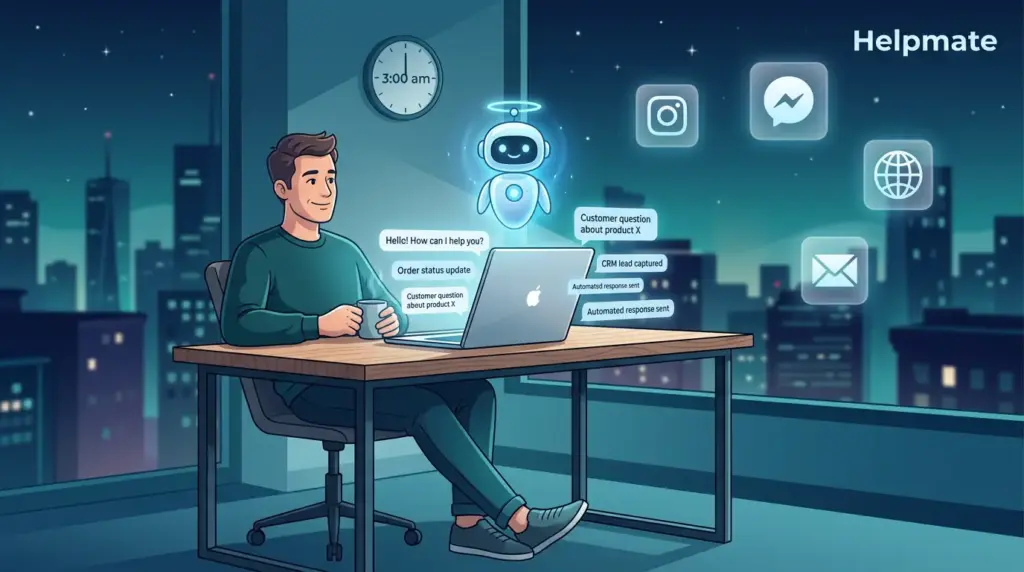
Last spring, Sarah Chen seriously considered shutting down her Shopify store. Her jewelry business had somehow grown from 50 orders a month to over 500, but there was this growing pile of customer messages she kept finding at 2 AM. Unanswered. She couldn’t swing a night shift team on her margins, but her competitors were somehow answering instantly at all hours. Something had to give.
TL;DR
- AI chatbots resolve around 70% of customer questions instantly without human intervention (Gartner, 2025).
- Automated escalation rules ensure complex issues reach humans at the right moment.
- Small e-commerce teams can now offer enterprise-grade 24/7 support at roughly 20% of traditional staffing costs.
- Unified CRM tracks every conversation across chat, social, and email in one place.
Why Is 24/7 Support Now Essential for Small E-Commerce?
64% of consumers expect 24/7 customer service availability (Salesforce, 2024). This used to be an enterprise thing, those big retailers with offshore call centers. Now it’s just… baseline. Sarah figured this out the painful way. Her Australian customers shopped during her midnight. European buyers asked sizing questions while she was asleep. Every message sitting there unanswered was either a refund request or a one-star review waiting to happen.
The math on hiring overnight staff didn’t work for her margins. A single support agent runs somewhere between $35,000 to $50,000 annually in most markets. Three shifts would triple that expense.
Poor availability has real costs. About 53% of shoppers abandon carts when they can’t get quick answers about shipping or product details (Baymard Institute, 2024). For small businesses, this compounds monthly.
Then there’s social commerce, which now drives roughly 30% of e-commerce traffic, and those platforms never close. Customers message Instagram pages at 11 PM expecting responses. When stores reply hours later, the buying moment has passed. The businesses winning market share have figured this out without adding headcount.
What Does 24/7 Customer Support Without Hiring Actually Look Like?
Providing 24/7 customer support without hiring means building a hybrid system where AI handles routine interactions and humans focus on high-value conversations. You’re not trying to replace people. You’re just extending their reach across hours and channels they couldn’t physically cover.
Sarah went with a unified platform that combined website chat, Instagram DMs, and Facebook Messenger into one inbox. Her AI chatbot was trained on her product catalog, shipping policies, and return procedures. It could answer “What size is this ring?” or “Do you ship to Canada?” instantly at 3 AM.
The thing Sarah realized—and this took her a few weeks—was tiered response design. Level one questions, product details, order status, shipping estimates, these consume about 70% of support volume. Perfect for automation. Level two questions, custom orders, complaints, complex troubleshooting, those need human judgment. The system routes these intelligently.
When Sarah wakes up now, she sees a prioritized queue. The AI has already handled 40 overnight conversations. Ten remain flagged for her attention with full context. She knows exactly which customers need personalized responses and which are already satisfied. Her effective capacity tripled without adding salary expense.
How Do AI Chatbots Handle Common Questions Without Sounding Robotic?
Modern AI chatbots use retrieval-augmented generation to produce contextual, natural responses rather than rigid scripts. This changed things significantly for small business automation.
Sarah trained her bot using her actual product descriptions, FAQ pages, and past support conversations. When a customer asks “Will this necklace tarnish?”, the AI doesn’t give some generic jewelry answer. It references the specific metals used in that product and explains the care instructions Sarah actually wrote.
The tone customization mattered more than she expected. Sarah configured her bot to sound warm and personal, matching her brand voice. She set guardrails so it admits uncertainty rather than making things up. When it doesn’t know something, it offers to connect with Sarah directly.
Image recognition adds another layer. Customers can upload photos of products they’re considering, and the AI identifies similar items in Sarah’s catalog. This turns conversations into sales without human involvement.
The bot also learns from every interaction. When Sarah corrects a response, that feedback improves future answers. After three months, her bot was resolving roughly 78% of inquiries without escalation. Customers often didn’t realize they were chatting with AI until told.
When Should Chatbots Escalate to Human Agents?
Smart escalation is what separates frustrating automation from actually helpful automation. The goal is minimizing wait times for urgent issues while keeping humans focused on problems requiring empathy and judgment.
Sarah configured her escalation triggers based on three criteria. First, sentiment detection flags angry or frustrated language. Second, specific keywords like “refund”, “broken”, or “lawyer” trigger immediate human routing. Third, failed resolution, when the bot can’t answer after two attempts, offers a handoff.
The timing of escalation matters. Sarah set business hours preferences so urgent issues during her sleep hours collect in a queue rather than waking her. For true emergencies, like payment failures, the system sends SMS alerts. This balances responsiveness with sustainable founder schedules.
The handoff experience needs to be seamless. When a conversation escalates, the human sees the full transcript and AI summary. Customers don’t repeat themselves. This reduces resolution time by roughly 40% compared to traditional ticket systems where each agent asks the same discovery questions.
For growing teams, the system supports collaborative assignment. Multiple team members can share the inbox with role-based permissions. New hires handle simple returns while senior staff manage VIP relationships. The AI pre-sorts everything.
How Do You Maintain Quality Across Time Zones and Channels?
Quality consistency is the biggest concern for founders considering automation. One bad AI interaction damages brand trust more than a delayed human response. The solution is unified knowledge management and continuous monitoring.
Sarah maintains a single source of truth. Her shipping policies, return windows, and product specifications live in one knowledge base that feeds every channel. Whether a customer messages via Instagram DM, website chat, or Facebook, they receive identical accurate information.
Regular auditing prevents drift. Sarah reviews conversation logs weekly, identifying where the AI stumbled and updating training data. She also monitors response time metrics. Her average response time dropped from 8 hours to 45 seconds for automated queries.
Language support extends reach without hiring translators. Modern AI handles 50+ languages natively. Sarah’s Australian customers get English responses. Her German buyers receive fluent German product descriptions. The system detects language automatically.
CRM integration ensures personalization at scale. When a repeat customer messages, the AI sees their order history and addresses them by name. “Hi Marcus, I see you bought the silver bracelet last month. Are you looking for matching earrings?” This level of personal touch was impossible with basic chatbots.
What ROI Can You Expect From Automated 24/7 Support?
The financial case for AI-powered support is compelling. Businesses implementing automated 24/7 support see 30% reduction in support costs within six months while handling higher volume (McKinsey, 2024).
Sarah calculated her ROI directly. Before automation, she spent 4 hours daily on support and was considering a $40,000 annual hire. After implementation, her daily support time dropped to 45 minutes. The platform cost a fraction of one month’s projected salary.
The revenue impact exceeded cost savings. Her cart abandonment rate dropped 18% after adding instant checkout support. Customers asking questions converted at 3x the rate of silent browsers. The 24/7 availability captured impulse purchases from international time zones that previously went unanswered.
Support quality metrics improved simultaneously. First response time decreased 94%. Customer satisfaction scores increased because instant answers delighted shoppers. Resolution rates climbed as the AI handled routine questions perfectly every time.
The scalability is transformative. When Sarah launched a viral product, her support volume tripled overnight. The AI absorbed the surge without breaking. Human agents would have faced impossible queues and burnout. Automation turned a crisis into manageable growth.
Ready to calculate your savings? Explore Helpmate’s AI support platform and see how quickly you can deploy 24/7 coverage without adding headcount.
Frequently Asked Questions
Yes. Around 67% of small e-commerce businesses now use AI chatbots to extend support hours without adding staff (HubSpot, 2025). The technology has become accessible and affordable for stores with as few as 100 monthly orders. Solutions like Helpmate – Live, Social & AI Chat with Built-in CRM integrate directly with WordPress and WooCommerce, requiring no technical team to implement.
AI chatbots respond within 1-2 seconds on average, compared to 2-10 minutes for human agents during peak hours. 83% of consumers expect immediate responses when contacting a business, and AI delivers this consistently regardless of time zone or volume. The speed advantage is most pronounced during nights and weekends when human staffing is minimal.
Well-trained AI chatbots resolve roughly 70-80% of tier-one support questions without human intervention. These include order status checks, shipping inquiries, product specifications, return policy questions, and basic troubleshooting. Complex issues requiring empathy, negotiation, or creative problem-solving still escalate to humans. The 20-30% requiring human touch receive faster attention because agents aren’t drowning in routine queries.
Frustration happens when bots can’t answer questions or pretend to be human. Around 78% of consumers are comfortable interacting with chatbots for simple tasks when the bot acknowledges its limitations and offers easy escalation. Modern AI trained on your specific products and policies provides more accurate answers than generic human agents who must look up details.
AI support platforms typically cost $50-300 monthly depending on conversation volume. A single full-time support agent costs $3,000-6,000 monthly including benefits. Automation reduces support costs by roughly 60-80% while increasing availability from 8 hours to 24 hours daily. Most businesses achieve positive ROI within 30 days of implementation.
Yes. Unified AI support platforms connect website chat, Facebook Messenger, Instagram DMs, WhatsApp, and email into one inbox. The AI maintains conversation context across channels. A customer might start on Instagram, continue on your website, and finish via email without repeating information. This omnichannel approach is essential for modern social commerce where customers expect seamless experiences.
Initial setup takes roughly 2-4 hours for most small businesses. Full optimization, where the bot achieves 70%+% resolution rates, typically requires 2-4 weeks of monitoring and feedback. Most platforms offer templates for common e-commerce scenarios that accelerate training significantly.
Conclusion
Providing 24/7 customer support without hiring is no longer aspirational. It’s achievable for businesses of any size using AI-powered automation. The key insights from Sarah’s experience and industry data are clear.
- AI chatbots resolve around 70% of inquiries instantly, extending your effective coverage from 8 hours to 24 hours.
- Smart escalation ensures complex issues reach humans with full context, maintaining quality for sensitive situations.
- Unified CRM and knowledge management keep responses accurate and personalized across all channels.
- ROI typically materializes within 30 days through cost reduction and increased conversion rates.
Start your 24/7 support transformation today. Discover Helpmate’s AI chatbot features and join thousands of businesses providing instant responses around the clock.
The technology has matured. The barrier is no longer technical capability. It’s willingness to embrace a new model where humans handle exceptions while AI manages routine interactions. For small e-commerce founders like Sarah, this shift meant surviving a growth surge that would have otherwise broken the business. For customers, it meant getting help exactly when they needed it. That’s the promise of modern 24/7 support without hiring.