TL;DR: Proactive sales strategies can increase conversion rates by up to 2.8x compared to passive support (LiveChat, 2025). This guide covers how to use behavioral triggers, timing, and personalization to engage visitors before they leave your site, turning browsers into buyers.
Did you know that 82% of buyers are open to meetings and purchases when sellers proactively reach out (Flowlu, 2026)? Yet, most e-commerce and lead-gen sites still rely on passive waiting, letting interested visitors slip away without a single interaction.
The challenge isn’t a lack of traffic; it’s the failure to engage that traffic at the exact moment of highest intent. When a visitor lingers on a pricing page or hovers over a “Buy Now” button, they are signaling a need for a nudge. Without proactive intervention, that signal often results in a bounce.
In this guide, you will learn the core strategies of proactive sales, from identifying the perfect engagement window to personalizing nudges that feel helpful rather than intrusive. We will also explore how WordPress site owners can automate these workflows using specialized tools.
Why Does Proactive Engagement Outperform Passive Support?
Proactive engagement is fundamentally about reducing friction. Research from LiveChat (2025) indicates that users who are invited to chat are 2.8 times more likely to convert than those who are not. This happens because proactive outreach removes the burden of initiation from the customer, providing immediate answers before they have to search for them.
Instead of waiting for a user to find a contact form and wait 24 hours for a reply, proactive chat intercepts the confusion the moment it starts. This immediacy is critical in a digital landscape where attention spans are short and competitors are just one click away.
Key Stat: Businesses that use live chat see an average increase in conversion rates of 20% (Alexander Jarvis, 2025). This lift comes from the ability to address objections in real-time, guiding the user through the decision-making process while they are still on the page.
Building Trust Through Presence
Trust is a major barrier to online sales. A proactive chat window acts as a digital storefront greeter, signaling that a real business is present and ready to help. This psychological reassurance can significantly lower bounce rates on high-intent pages like pricing and checkout.
How Do You Identify the Right Moment to Engage?
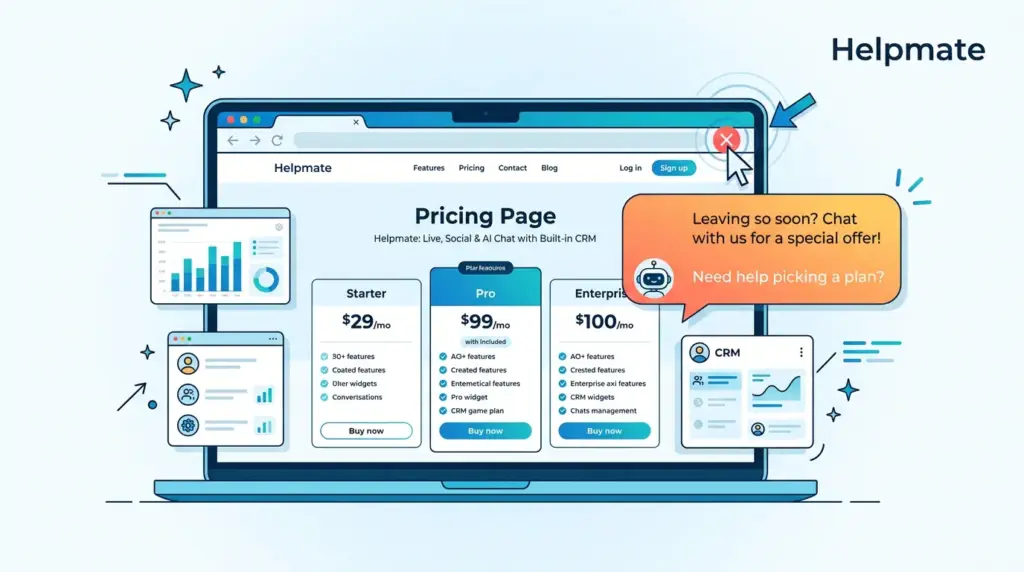
Timing is the difference between a helpful nudge and an annoying interruption. The right moment is defined by behavioral intent signals, not arbitrary timers. If you trigger a chat too early, you annoy them. Too late, and they have already decided to leave.
According to a 2026 report by Cuevr, 60% of business leaders now consider sales prospecting a strategic priority, which underscores the need for precision in digital outreach. Identifying these signals requires tracking specific user behaviors that indicate hesitation or confusion.
Top Behavioral Triggers
- Exit Intent: Triggering a message when the cursor moves toward the close button captures the user right before they bounce.
- Page Dwell Time: Engaging after 30-60 seconds on a product or pricing page suggests the user is reading and processing information.
- Scroll Depth: Reaching 70-80% of a page often indicates high interest in specific content.
- Cart Abandonment: The most critical trigger. Catching a user who adds an item but stalls at checkout is a high-conversion opportunity.
Using Intent Scoring
Advanced systems combine these triggers into an intent score. For example, a visitor who lands on a pricing page and stays for 45 seconds is a higher priority than a casual blog reader. Targeting these high-value segments ensures your resources are focused where they matter most.
What Are the Most Effective Chat Nudges for Sales?
Once you have the timing right, the message must be compelling. Generic greetings like “Can I help you?” are easy to ignore. Effective nudges are specific, value-driven, and personalized to the user’s current context.
Personalization is key. Using data you already have, such as the page they are on or their past history, makes the interaction feel less robotic. For instance, a returning customer should be greeted differently than a first-time visitor.
Examples of High-Converting Nudges
- On Pricing Pages: “Looking for the right plan? Let me help you compare features.”
- On Product Pages: “Got questions about this item? I can check stock or shipping times for you.”
- On Checkout: “Need help with payment? We accept several secure methods.”
These messages focus on removing barriers rather than just selling. By positioning the chatbot for business as a support tool that facilitates the sale, you reduce the perceived pushiness.
How Do You Avoid the ‘Pushy Salesperson’ Perception?
The biggest fear site owners have is annoying their visitors. The line between proactive and pushy is defined by value and frequency. If every interaction offers a clear benefit to the user, it is perceived as helpful.
Research shows that proactive sellers see 82% of buyers accepting meetings (Salesgenie, 2026). This high acceptance rate is only possible when the outreach is relevant. Irrelevant or overly frequent messages trigger a negative reaction, leading to higher bounce rates.
Rules for Respectful Engagement
- Limit Frequency: Do not trigger a new message if the user has already dismissed one. Respect their choice.
- Offer an Exit: Always make the chat easy to minimize or close.
- Contextual Relevance: Ensure the message matches the page content. A chat about “shipping returns” on a blog post about “gardening tips” is confusing.
The Role of AI Tone
Your chatbot’s tone should be set to be helpful and conversational. Avoid aggressive sales language. Instead of “Buy Now,” use “Ready to get started?” or “Want to see how this works?” The goal is to assist the decision, not force it.
Can Proactive Sales Work on Autopilot?
Manual proactive sales are impossible to scale. This is where automation and AI chatbots become essential. With the right tools, you can set up rules that trigger specific messages based on user behavior, 24/7.
Modern WordPress plugins allow you to define “campaigns” or “automations.” For example, you can create a rule: “If a user is on the ‘Pricing’ page for more than 40 seconds, send message X.” If they reply, the conversation can then be handed off to a live agent.
Integrating with CRM
Proactive chat should not exist in a silo. Every interaction is a data point. By integrating chat with a WordPress CRM, you can track which proactive messages led to conversions, allowing you to refine your strategy over time.
This data-driven approach transforms chat from a simple communication tool into a powerful sales engine. It allows you to identify which triggers work best for different segments of your audience.
How to Measure the ROI of Proactive Chat?
What gets measured gets managed. To justify the investment in proactive sales strategies, you need to track specific KPIs that reflect both engagement and revenue impact.
A key statistic to keep in mind is that 49% of businesses report increased conversions specifically due to live chat implementation (GoSquared, 2025). To achieve similar results, you must track the right metrics.
Essential Metrics to Watch
| Metric | Why It Matters |
|---|---|
| Chat-Triggered Conversion Rate | Measures how many sales started with a chat interaction. |
| Response Time | Faster responses correlate with higher satisfaction and conversion. |
| Engagement Rate | Shows what percentage of visitors accept the proactive nudge. |
| Revenue Per Chat | Calculates the direct financial impact of your chat strategy. |
Regularly reviewing these metrics helps you optimize your triggers and messages. If a specific nudge has a low engagement rate, it is a sign that it needs to be reworked or targeted at a different segment.
What Are the Best Practices for Chatbot Timing and Tone?
The final piece of the puzzle is refining the user experience. Even with perfect triggers and personalized messages, a poor tone or bad timing can ruin the interaction. The goal is to create a seamless bridge between browsing and buying.
Industry benchmarks suggest that the average live chat response time should be under 4 minutes to maintain user interest (Nextiva, 2026). With automation, you can respond instantly, setting the stage for a positive experience.
Tone Guidelines
- Conversational: Use natural language. Avoid corporate jargon.
- Empathetic: Acknowledge the user’s situation. “I see you are looking at our enterprise plans.”
- Helpful: Always offer a solution or next step. Don’t leave the user hanging.
Timing Refinements
Consider the device. Mobile users often have different browsing patterns than desktop users. They may scroll faster but have less patience for interruptions. Adjust your triggers based on the device to ensure the best experience for every visitor.
Conclusion
Proactive sales strategies are no longer optional for businesses that want to maximize their online potential. By engaging visitors at the right moment with the right message, you can significantly increase conversions and build lasting customer relationships.
Remember the key takeaways:
- Proactive engagement can boost conversion rates by 2.8x (LiveChat, 2025).
- Behavioral triggers like exit intent and dwell time are your most powerful tools.
- Personalization and a helpful tone are essential to avoid the “pushy” perception.
- Automation allows you to scale these efforts 24/7 without overwhelming your team.
By implementing these strategies, you turn your website from a static brochure into an active, intelligent sales environment.
Frequently Asked Questions
Proactive sales chat is a strategy where a business initiates a conversation with website visitors based on their behavior, such as time spent on a page or exit intent. It aims to provide assistance and guide the user toward a purchase before they leave the site.
Proactive chat increases conversions by reducing friction and addressing user questions in real-time. By offering help at the exact moment of hesitation, you prevent the user from leaving to find answers elsewhere, keeping them engaged in your sales funnel.
The most effective triggers include exit intent (when a user moves to close the tab), extended dwell time on pricing or product pages, deep scrolling, and cart abandonment events. These signals indicate high intent or confusion that proactive chat can resolve.
You can implement proactive sales in WordPress using plugins like Helpmate, which offers a Proactive Sales module. This allows you to set specific behavioral triggers, personalize messages, and integrate the chat with your CRM for tracking and follow-up.
No, proactive chat is helpful when done correctly. The key is relevance and frequency. Unlike spam, proactive chat should only trigger when a behavioral signal suggests the user needs help, and it should always offer an easy way to close the conversation.