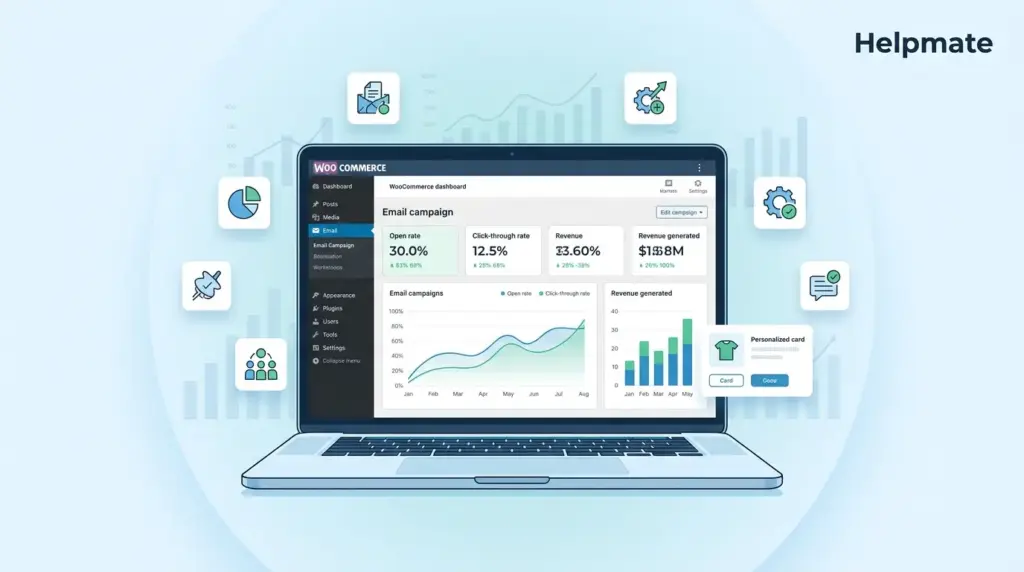
TL;DR: Email marketing still delivers something like $36 for every dollar you put in—at least that’s what the reports keep saying. Whether that exact number holds for your store depends on execution, but the underlying point stands: email crushes most other channels for WooCommerce stores. The campaigns that actually work in 2026 go way beyond slapping a first name in the subject line. You need real segmentation, triggers based on what customers actually do, and personalization that feels like you remember them, not like a robot does. This guide walks through timing strategies, the email types that actually convert, and how to connect your email efforts with CRM data for unified customer experiences.
Most store owners I talk to know they should be doing email marketing, but there’s this gap between knowing and doing. You set up the basic WooCommerce emails—order confirmations, maybe a receipt—and then you get busy with everything else. Ads need adjusting. Inventory needs counting. Suddenly it’s three months later and your “newsletter” is just you blasting the same promotion to everyone who ever checked out, wondering why open rates sit at 15% and nobody clicks.
Here’s the thing: with acquisition costs climbing pretty much everywhere—Facebook, Google, you name it—email is the one channel where you’re not renting your audience. You own that list. And the stores that figure this out in 2026 are the ones treating email less like a billboard and more like… well, like a conversation you’d actually have with a customer who walked into your shop.
In this guide, we’re going to look at how to build campaigns that feel less robotic. Segmentation that makes sense. Automation that doesn’t sound automated. Timing that matches how people actually shop. Whether you’re starting from zero or trying to fix a program that’s plateaued, these are the patterns I’ve seen work—sometimes after a few failed attempts first.
Explore Helpmate’s e-commerce AI tools to unify your email marketing with chat, social, and CRM data.
Why Email Still Matters (Despite What the Headlines Say)
Every few years someone declares email is dead. Social media was supposed to kill it. Then messaging apps. Then TikTok, probably. But email keeps chugging along—last I checked, Litmus was reporting something like $36 back for every $1 spent, which beats pretty much everything else you could be doing with your marketing budget.
The reason email hangs on comes down to ownership and intent. You don’t own your Instagram followers—Meta does, and they’ll happily charge you to reach them. But that email address someone gave you when they signed up for a discount code? That’s yours. And more importantly, someone handing over their email is a signal. They’ve raised their hand and said, “I’m interested enough to let you into my inbox.” That person converts way better than someone who just got served a cold ad.
Three things are making email especially potent for WooCommerce merchants heading into 2026:
- First-party data is suddenly crucial: With third-party cookies getting phased out and privacy laws tightening, you can’t rely on tracking pixels the way you used to. Email becomes your primary way to understand what customers actually want—based on what they bought, what they browsed, what they abandoned.
- Automation has gotten actually good: The tools available now can trigger sequences based on real behavior, not just time delays. Someone browses hiking boots but doesn’t buy? You can follow up with content about trail conditions in their area. That’s different from the old “wait three days and send a generic newsletter” approach.
- Integration isn’t painful anymore: Modern email platforms plug into WooCommerce without requiring a computer science degree. Dynamic product recommendations, inventory-aware campaigns, customer profiles that actually reflect purchase history—it’s all doable now without custom development.
Stores that treat email as an afterthought—something they get to when they remember—are leaving money on the table. The ones winning right now view every email as a chance to build a relationship, not just make a sale. There’s a difference.
Segmentation: Stop Blasting Everyone
Here’s a number that stuck with me: segmented campaigns drive roughly 760% more revenue than sending the same thing to your whole list. I had to read that twice the first time I saw it. Seven hundred and sixty percent. The caveat, of course, is that “segmented” means actually segmented—thoughtfully, based on data that matters—not just splitting your list into “customers” and “non-customers.”
After working with a bunch of different WooCommerce stores, I’ve landed on four segmentation approaches that actually move the needle:
Behavioral Segmentation
This is the big one. What people do matters more than who they say they are. Look at:
- How often they buy—first-timers need different treatment than your VIPs with ten orders
- When they last bought—someone who purchased last week is in a completely different headspace than someone who hasn’t bought in eight months
- What they spend—your high AOV customers probably don’t care about 10% off, but they might care about early access
- What they look at but don’t buy—this is gold for browse abandonment and price-drop campaigns
Product-Based Segmentation
Seems obvious, but you’d be surprised how many stores send hiking gear recommendations to someone who only ever bought formal wear. Group people by what they’ve purchased or even just what they’ve spent time looking at. Cross-sells work roughly 3x better when they’re relevant to purchase history versus just pushing your bestsellers to everyone.
Engagement-Based Segmentation
Track how people interact with your emails, not just your store:
- Your superfans—consistent openers and clickers who should get VIP treatment, early access, maybe a loyalty program invite
- The middle group—opens sometimes, clicks occasionally. These folks need reactivation or stronger hooks
- The ghosts—haven’t opened in 90+ days. They’re hurting your deliverability and need either a win-back campaign or a graceful exit
Demographic and Preference Segmentation
Demographics alone aren’t that useful—knowing someone is 34 and lives in Ohio doesn’t tell you much about what they want to buy. But combined with behavioral data, preferences can refine messaging. The key is asking. Post-purchase surveys, preference centers, even simple questions during signup about what content they want—this stuff matters. Just don’t make the form so long that nobody finishes it.
The Email Types That Actually Drive Revenue
Not every email should be asking for a sale. The best programs mix different email types, each with its own job. Think of it like a conversation—you wouldn’t walk up to someone and immediately ask them to buy something. (Well, you could, but you’d be that person at the party nobody wants to talk to.)
Welcome Series
Welcome emails are weirdly powerful. The data says they generate something like 320% more revenue per email than regular promotional blasts. I think it’s because the timing is right—someone just gave you permission to contact them, they’re thinking about your brand, they’re warm.
A solid welcome series usually runs 3-5 emails over the first week:
- First email: Immediate. Confirm their account, tell your story (briefly), give them a reason to make that first purchase
- Second email: Social proof. What do other customers love? Reviews, bestsellers, that kind of thing
- Third email: Education. Help them solve a problem your products address. Not a sales pitch—actual help
- Fourth email: Show them around. Personalized recommendations based on what they browsed before signing up
- Fifth email: The nudge. If they haven’t bought yet, a time-sensitive offer can push them over the edge
Abandoned Cart Recovery
Cart abandonment is brutal—something like 70% of carts get abandoned across e-commerce. But abandoned cart emails recover 10-15% of those, which adds up fast.
The sequence that seems to work: First email an hour after abandonment. Just a reminder—”Hey, you left this behind.” Second email at 24 hours. Address objections. Maybe they had questions about shipping or returns. Third email at 48-72 hours. This is where a modest incentive makes sense—free shipping, maybe a small discount. Don’t lead with the discount in email one; you’ll train people to abandon carts just to get coupons.
Include product images, make the CTA obvious, add trust signals. And for the love of all that is holy, make sure it looks good on mobile. Over 60% of abandonment happens on phones.
Post-Purchase Sequences
The moment after someone buys is when they’re most engaged with your brand. Don’t waste it. Post-purchase emails should:
- Confirm the order (obviously) and set expectations for delivery
- Provide instructions—how to use the product, care guides, setup help
- Ask for reviews, but time it right. Not immediately; give them a chance to actually use the thing
- Suggest complementary products, but gently. They just bought from you; don’t be greedy
- Invite them to your loyalty program if you have one
Re-engagement and Win-Back Campaigns
For subscribers who haven’t purchased in six months or more, re-engagement campaigns can recover maybe 10-15% of them. These emails need to acknowledge the elephant in the room—”We haven’t seen you in a while”—and give them a compelling reason to come back. Sometimes it’s a special offer. Sometimes it’s just asking if they want different content. And sometimes, you have to let them go. Inactive subscribers hurt your deliverability with Gmail and the others. Better a smaller engaged list than a big dead one.
Timing: When to Actually Hit Send
Timing matters more than most people think. Send at the wrong moment and your carefully crafted email gets buried under a pile of work emails or scrolled past during the evening Netflix scroll.
Days of the Week
Tuesday through Thursday tends to work best for promotional emails. Mondays are chaos—weekend buildup, work catching up, everyone’s in triage mode. Friday afternoons, people are mentally checked out. Weekends can work for lifestyle brands, but B2B-adjacent e-commerce usually sees lower engagement. That said, test this. Your audience might be different.
Time of Day
Mid-morning—around 10 or 11 AM—and early evening, like 5-7 PM in the recipient’s local timezone, usually get the best engagement. People check personal email after they’ve cleared the morning work stuff, and again during commutes or after dinner. But triggered emails work differently:
- Welcome emails: Send immediately. Like, within seconds. The moment is hot
- Abandoned cart: 1 hour, then 24 hours, then 72 hours after abandonment
- Post-purchase: Immediately for confirmation, then timed around delivery
- Browse abandonment: 2-4 hours after they leave your site
Seasonal Timing
Q4 is a mess. Everyone’s sending holiday campaigns, inboxes get flooded, and standing out is harder. Start earlier—October for holiday campaigns. And think about product cycles. Don’t try to sell winter coats in January when everyone already bought them. Start in September. Replenishment products? Time them based on how long your product typically lasts. If someone bought a 30-day supply, email them around day 25.
Personalization That Goes Beyond “Hi [First Name]”
Everyone knows the first-name merge tag trick by now. It’s table stakes. Real personalization in 2026 means using what you actually know about the customer—their purchase history, what they looked at, how they interact with your brand.
Dynamic Product Recommendations
Recommendations based on actual behavior work. Show them:
- Items frequently bought with what they already purchased—”People who bought your hiking boots also grabbed these wool socks”
- Stuff they looked at but didn’t buy
- New arrivals in categories they clearly care about
- Price drops on things they abandoned or wishlisted
Emails with personalized product recommendations convert about 26% better than generic promotional blasts. That’s significant.
Behavioral Triggers
Set up campaigns that respond to specific actions:
- Back-in-stock notifications for things they viewed that were out of stock
- Price drops on abandoned cart items—”That jacket you liked just went on sale”
- Loyalty updates showing their points balance, what they can redeem
- Replenishment reminders based on typical usage cycles
Content Personalization
Tailor the actual content blocks in your emails. First-time buyers get your brand story and educational content. VIPs get early access to sales. Category buyers see relevant blog posts. People in different locations get geographically relevant messaging—events, shipping info, local references.
The Helpmate CRM can capture conversation history from chat and social DMs. So when someone asks about specific products via live chat, that context can shape what emails they get later. It creates a unified experience instead of these disconnected touchpoints where the left hand doesn’t know what the right hand is doing.
Automation Workflows That Run While You Sleep
This is where email gets really powerful. Automation workflows are always on, always working, generating revenue while you’re doing other things. The difference between stores that crush email and those that struggle is often just how sophisticated their automation is.
The Welcome Workflow
Automated welcome sequences generate something like 9x more revenue than broadcast emails. Structure it to educate, build trust, and guide toward that first purchase. And use progressive profiling—ask one or two questions in each email to gather preference data that improves your segmentation later.
The Abandoned Cart Workflow
With abandonment rates around 70%, recovery is essential. Multi-stage sequences work better than single emails—up to 15% recovery with a three-email sequence. The key is addressing different abandonment reasons. Maybe they got distracted. Maybe shipping was too expensive. Maybe they had a technical issue. Your emails should speak to these different possibilities.
The Post-Purchase Nurture Workflow
Retention is way cheaper than acquisition—somewhere between 5x and 25x cheaper depending on which study you believe. Post-purchase workflows should maximize satisfaction, generate reviews, and encourage repeat purchases. Time them around delivery confirmation, product usage milestones, and replenishment cycles.
The Win-Back Workflow
Re-engaging lapsed customers often beats acquiring new ones. Win-back workflows should acknowledge the relationship—”We miss you”—offer real value, and make it easy to come back. Include a preference center so they can adjust frequency instead of unsubscribing completely. Sometimes people just want fewer emails, not zero.
Tools like Helpmate – Live, Social & AI Chat with Built-in CRM let you integrate email automation with chat and social. So when a customer asks about a product via Instagram DM, that interest can automatically trigger relevant email nurture sequences. The channels start talking to each other.
Ready to automate your email campaigns? Get started with Helpmate’s automation workflows for WooCommerce.
Measuring What Actually Matters
You can’t improve what you don’t measure. But most people measure the wrong things—vanity metrics that feel good but don’t translate to revenue.
The Metrics That Actually Matter
| Metric | Benchmark | Why It Matters |
|---|---|---|
| Open Rate | 15-25% | Tells you if your subject lines work and if you’re landing in inboxes |
| Click-Through Rate | 2-5% | Measures whether your content is relevant and your CTAs are clear |
| Conversion Rate | 1-3% | Shows actual revenue impact—this is the number that pays the bills |
| Revenue Per Email | $0.10-$0.50 | Lets you compare campaigns apples-to-apples |
| Unsubscribe Rate | <0.5% | Warning signal—if this spikes, you’re emailing too much or sending irrelevant stuff |
A/B Testing That Actually Works
Test systematically. Don’t change ten things at once or you’ll never know what moved the needle. Prioritize in this order:
- Subject lines—emotional triggers, personalization, urgency, curiosity
- Send times—test different days and times for your specific audience
- Content layout—image-heavy vs. text-heavy
- CTA buttons—color, text, placement
- Offers—percentage off vs. dollar amounts, free shipping thresholds
List Hygiene and Deliverability
The best email in the world is useless if it hits the spam folder. Remove hard bounces immediately. Suppress soft bounces after repeated failures. Sunset unengaged subscribers after 6-12 months of inactivity. And set up authentication—SPF, DKIM, DMARC. These aren’t optional anymore.
Attribution and Revenue Tracking
Connect email performance to actual WooCommerce revenue. Use UTM parameters for Google Analytics. Enable e-commerce tracking in your email platform. And track assisted conversions—emails often influence purchases even when another channel drives the final click.
Frequently Asked Questions
It depends—on your audience, your products, your content value. Most successful WooCommerce stores I see send 2-4 promotional emails per week, plus transactional stuff that’s triggered by behavior. Watch your unsubscribe rate—that’s your canary in the coal mine. If it spikes above 0.5% per email, you’re probably pushing too hard. Segment your list so your engaged subscribers get more frequent touches while less active ones hear from you weekly or bi-weekly.
E-commerce open rates typically fall in the 15-25% range, with segmented campaigns doing better than broadcast blasts. Welcome emails often see 40-60% open rates because the timing is right. Promotional campaigns to established subscribers usually hit 18-22%. If you’re consistently under 15%, look at your subject lines, your list hygiene, and your sender reputation. Something’s off.
Double opt-in produces higher quality lists with better engagement, though you’ll lose 20-30% of subscribers in the confirmation step. For most WooCommerce stores, that quality improvement is worth the trade-off. But if you’re in a fast-moving market or targeting mobile-first audiences where email confirmation creates major drop-off, single opt-in with strict validation might work better. Test it if you’re unsure.
Integration means connecting your email platform to WooCommerce via API or plugin. Key pieces: syncing customer data and purchase history, triggering abandoned cart sequences, sending post-purchase follow-ups, and tracking email-influenced revenue. Solutions like Helpmate CRM offer native WooCommerce integration, letting you create segments based on purchase behavior and trigger campaigns from store events.
A solid abandoned cart sequence recovers 10-15% of abandoned carts. Single emails typically get 5-8%, while three-email sequences with good timing and strategic incentives hit the higher end. Recovery rates vary by industry—luxury goods often see lower recovery because of longer consideration cycles, while consumable products tend to recover at higher rates.
Combine exit-intent popups with first-purchase discounts, content lead magnets that actually relate to your products, post-purchase referral incentives, and social media promotion. Checkout opt-in with clear value propositions works well too. Chat widgets like Helpmate can capture emails during conversations. But focus on quality over quantity—a smaller engaged list will always outperform a large unengaged one.
GDPR, CCPA, and other privacy laws require clear consent documentation, easy unsubscribe mechanisms, data access and deletion capabilities, and transparent privacy policies. Every email needs a functional unsubscribe link processed within 10 days. Keep records of when and how subscribers joined your list. Use double opt-in where possible to demonstrate consent. And consult legal counsel for specifics—this stuff gets complicated and varies by jurisdiction.
Putting It Together: Your 2026 Strategy
Email still delivers the highest ROI for WooCommerce stores, but the bar has moved. Basic newsletters don’t cut it anymore. The stores winning in 2026 are combining:
- Segmentation that goes beyond surface-level demographics
- Automation triggered by actual customer behavior, not just time delays
- Personalization that uses purchase history and browsing data
- Continuous testing and optimization based on revenue, not vanity metrics
- Integration with chat, social, and CRM for unified customer views
Your email list is your most valuable owned asset. Treat it that way. Send relevant content. Respect frequency—nobody wants daily emails unless they’re truly valuable. And make every message worth opening.
The investment in building sophisticated email campaigns pays off through higher customer lifetime value, lower acquisition costs, and revenue that doesn’t depend entirely on ad platforms. Start by auditing what you’re doing now against the practices outlined here. Build your workflows systematically. And start small if you need to—one automated sequence beats ten broadcast emails that nobody reads.
The sooner you start, the sooner you’ll see the compound effect that good email marketing creates. It’s not instant, but it is lasting.