
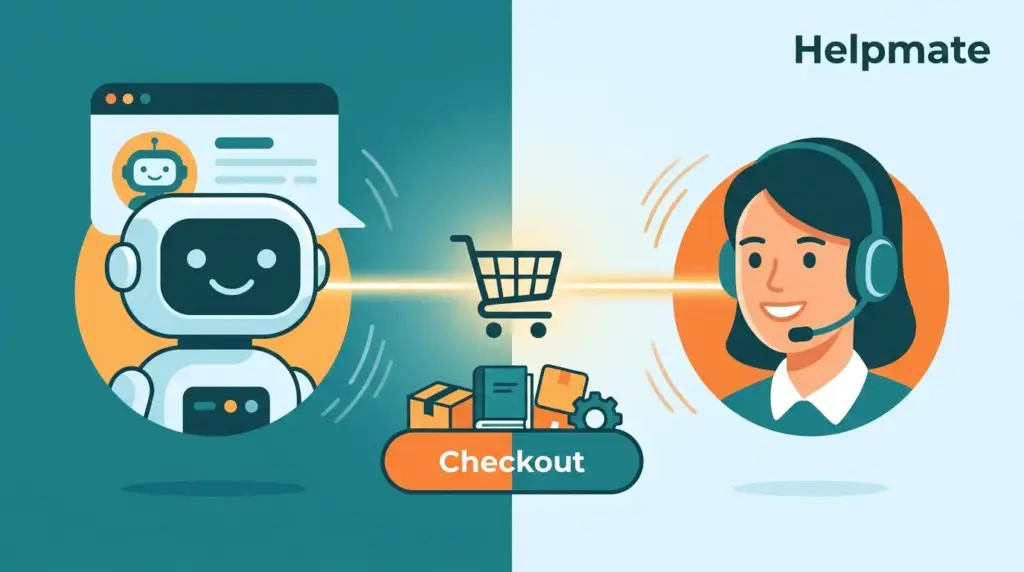
TL;DR: Conversation marketing is about having real-time, one-to-one interactions—across chat, social, email—to move people toward buying. E-commerce brands running these kinds of conversational tactics see up to 20% higher conversions (Drift, 2024). This guide covers 7 examples with templates you can use right away.
Most e-commerce stores lose about 70% of potential customers before checkout. The cart abandonment rate sits at 70.19% (Baymard Institute, 2025), which is kind of wild when you think about it—seven out of ten shoppers just walk away.
Conversation marketing tries to change that. Instead of letting customers fend for themselves, you show up with timely, personalized messages when they’re actually deciding whether to buy. When it works well, you get higher conversions, better loyalty, and a customer experience that doesn’t feel like pulling teeth.
Below are 7 conversation marketing examples that have shown real results. Each one includes the thinking behind it, what actually happened, and a template you can adapt for your own store.
What Is Conversation Marketing and Why Does It Matter?
Conversation marketing is basically a customer-first approach that uses real-time dialogue to guide people through the buying process. Instead of just pushing messages at them, it creates actual two-way conversations across live chat, social media, email, and AI chatbots.
Research from Forrester shows 79% of consumers prefer live chat over other channels—they want answers now, not in 24 to 48 hours. When you meet people where they are with relevant responses, trust tends to build on its own.
The business impact is real. Companies using conversational marketing strategies report around a 20% increase in conversions on average (Drift, 2024). The reason is pretty straightforward: conversations reduce friction, answer objections in real time, and create personalized paths to purchase.
How Conversation Marketing Differs From Traditional Marketing
Traditional marketing broadcasts messages to broad audiences. Conversation marketing listens and responds to individual needs. Think of it as the difference between a megaphone and a helpful sales associate who actually pays attention to what you need.
The main differences: immediacy over delay, personalization over segmentation, dialogue over monologue, and relationship building over transaction extraction. It’s a shift in mindset, and it requires different tools, but the returns are measurable.
1. Pre-Sale AI Chatbot for Product Recommendations
AI-powered chatbots now handle the critical first touchpoint for a lot of e-commerce visitors. Gartner predicts that by 2027, chatbots will be the primary customer service channel for roughly a quarter of organizations. Some smart retailers are already using this tech to qualify leads and recommend products around the clock.
The best pre-sale chatbots ask qualifying questions before making recommendations. For example, a skincare brand might ask about skin type, budget, and specific concerns before suggesting three tailored products. It’s kind of like the in-store experience where a knowledgeable associate guides your selection—except it happens at 2am.
Getting this right requires a solid foundation. Our guide to building a WordPress knowledge base explains how to train your AI with product data for accurate recommendations.
Template: Product Recommendation Flow
Greeting: Welcome! I can help you find the perfect product. What brings you here today?
Qualifying Question 1: What is your main goal? (Options: gift, personal use, business)
Qualifying Question 2: What is your budget range?
Recommendation: Based on your answers, here are three options that match. Would you like to learn more about any of them?
2. Abandoned Cart Recovery Through Proactive Chat
Cart abandonment costs e-commerce businesses billions every year. The average abandonment rate is 70.19% across industries (Baymard Institute, 2025). But here’s the thing—brands using proactive chat triggers during checkout see recovery rates jump from the typical 3-5% up to 10-15%.
The strategy works by detecting exit intent or using time-based triggers to deliver a timely message. Unlike email follow-ups that show up hours later, chat catches the customer at the exact moment of hesitation. A simple message addressing common objections can save the sale. This is a core capability for e-commerce AI tools.
Template: Cart Recovery Message
Trigger: User hovers over exit button with items in cart.
Message: Hey! I noticed you are still considering these items. Need help with sizing, shipping, or have any questions before you check out?
Follow-up: As a thank you for chatting, here is 10% off your order. Use code SAVE10 at checkout.
3. Social Media DM Automation for Lead Capture
Social media has basically become a shopping channel. A Sprout Social report found that 76% of consumers have purchased something they discovered on a brand’s social media feed. The challenge is turning that interest into leads before it just… disappears.
Automated DM responses to comments and story replies capture leads at the moment of highest interest. When someone comments on a product post asking about availability, an instant DM with details and a purchase link keeps the momentum going. This is a powerful social engagement AI strategy.
Template: Instagram Comment-to-DM Flow
Trigger: User comments with a keyword like “PRICE” or “LINK” on a product post.
Auto-Reply: Thanks for your interest! I just sent you a DM with all the details and a direct link to shop.
DM Content: Hey [Name]! Here is the information about [Product]. Ready to order? Here is your direct link: [URL]. Any questions, just reply here!
4. Live Chat Handoff for Complex Purchases
Some purchases just need human expertise. High-value items, B2B services, and complex products benefit a lot from live chat with trained reps. Studies show live chat has the highest satisfaction rate of any customer service channel—about 73% (American Marketing Association).
The key is making the handoff from AI to human agents feel seamless. The chatbot handles initial qualification and simple questions, then transfers the conversation with full context when a human touch actually adds value. That efficiency means your team focuses on high-impact interactions instead of answering the same basic questions all day.
Template: AI-to-Human Handoff
AI Bot: I can help with most questions! For detailed customization options, let me connect you with a specialist.
Transfer Message: Connecting you with Sarah now. She has the context of our conversation so you will not need to repeat anything.
Human Agent: Hi [Name], Sarah here. I see you are interested in [Product] and had questions about customization. Let me help you design the perfect solution.
5. Post-Purchase Check-In and Cross-Sell
The conversation doesn’t end at purchase. Post-purchase engagement drives repeat business and lifetime value. Research from Bain and Company shows that increasing customer retention by just 5% can boost profits by 25 to 95%—that’s a range that keeps getting cited because it’s genuinely impressive.
A simple check-in message asking about the customer experience opens doors for reviews, referrals, and complementary product suggestions. Timing matters though: send the first check-in 3 to 5 days after delivery, then follow up with relevant cross-sells based on what they bought.
Template: Post-Purchase Sequence
Day 3: Hi [Name]! Your order should have arrived by now. How are you enjoying it? Any questions about getting started?
Day 7: Glad you are loving it! Customers who bought this also love [Complementary Product]. Want to see how they work together?
Day 14: Would you mind sharing a quick review? It helps other customers like you find the right product.
6. WhatsApp Business Conversations for Order Updates
WhatsApp has over 2 billion active users globally, and 87% say they’d use it again for business communication (Meta, 2024). For e-commerce brands, WhatsApp provides an intimate channel for transactional updates that customers actually open—unlike most of their email.
Order confirmations, shipping updates, and delivery notifications via WhatsApp see open rates exceeding 90%, compared to email rates around 20%. The conversational nature of the platform also invites replies, creating natural touchpoints for additional engagement. Setting this up requires connecting your channels through social chat management tools.
Template: WhatsApp Order Flow
Order Confirmation: Hi [Name]! Your order #[12345] is confirmed. We are preparing it now. Estimated delivery: [Date]. Reply HELP for assistance.
Shipping Update: Great news! Your order is on its way. Track it here: [Link]. Need to change delivery instructions? Reply now.
Delivery Confirmation: Your order has arrived! We hope you love it. Questions or feedback? Just reply to this message.
7. Loyalty Program Conversations and Re-Engagement
Loyalty programs work best when they feel personal rather than transactional. A Bond Brand Loyalty report found that 79% of consumers say loyalty programs make them more likely to keep doing business with a brand. Adding a conversation layer makes the whole thing feel more genuine.
Proactive messages about points balances, exclusive offers, and milestone celebrations keep customers engaged between purchases. The key is relevance: send messages that align with each customer’s purchase history and preferences. This is where CRM capabilities become essential for segmenting and targeting customers effectively.
Template: Loyalty Re-engagement
Milestone Message: Congratulations [Name]! You have earned 500 points and unlocked Gold status. As a thank you, here is an exclusive 20% off your next order.
Inactivity Trigger: We miss you! It has been 30 days since your last visit. Your points are waiting. Come see what is new and use your rewards before they expire.
Win-back Offer: [Name], we saved something special for you. As a valued Gold member, get early access to our new collection launching Friday. Want a sneak peek?
How to Implement Conversation Marketing in Your Business
Starting with conversation marketing doesn’t have to mean overhauling everything. Pick one high-impact touchpoint and build from there. The most common starting points are live chat on product pages and abandoned cart recovery messages.
A unified platform like Helpmate combines live chat, AI chatbots, social media messaging, and CRM into a single WordPress system. That eliminates the pain of managing multiple tools and ensures conversations flow seamlessly across channels. Learn more about Helpmate’s AI chatbot features to see how all these elements work together.
Implementation Checklist
- Identify your top three customer touchpoints where conversations add value
- Start with AI chatbot for basic qualification and FAQs
- Set up abandoned cart triggers with personalized messaging
- Connect social media channels for unified inbox management
- Create response templates for common scenarios
- Train your team on seamless AI-to-human handoffs
- Measure results and iterate based on customer feedback
Frequently Asked Questions
Conversation marketing is a customer engagement strategy that uses real-time, two-way dialogue across channels like live chat, social media, and AI chatbots to guide prospects through the buying journey. Companies using this approach report up to 20% higher conversion rates (Drift, 2024).
Proactive cart recovery chat can increase recovery rates from the typical 3-5% to 10-15% (Contentsquare, 2025). The key advantage over email is timing: chat intercepts the customer at the moment of hesitation rather than hours later.
AI chatbots handle 80% of routine inquiries effectively, but the best results come from combining AI with human agents. Gartner predicts chatbots will be the primary customer service channel for 25% of organizations by 2027, but complex issues still benefit from human expertise.
Live chat on your website, Instagram DMs, and WhatsApp are the top performing channels. Live chat has 73% satisfaction rates (AMA), WhatsApp messages see 90%+ open rates (Meta), and 76% of consumers have purchased from social media discoveries (Sprout Social).
Start with one high-impact touchpoint, typically live chat on product pages or abandoned cart recovery. Use a platform like Helpmate that combines AI chatbot, live chat, and social messaging in one system to avoid tool sprawl and ensure seamless customer experiences.
Key Takeaways
- Conversation marketing uses real-time dialogue to guide customers through the buying journey, driving up to 20% higher conversions
- AI chatbots handle qualification and FAQs while human agents tackle complex issues
- Abandoned cart chat recovery outperforms email with 10-15% recovery rates
- Social media DMs capture leads at peak interest moments
- Post-purchase conversations drive retention and repeat business
- Start with one touchpoint, measure results, then expand your conversation strategy
Ready to put these conversation marketing examples into action? Helpmate combines AI chatbot, live chat, social messaging, and CRM into one WordPress system. Start building genuine customer conversations that convert.