Key Takeaways
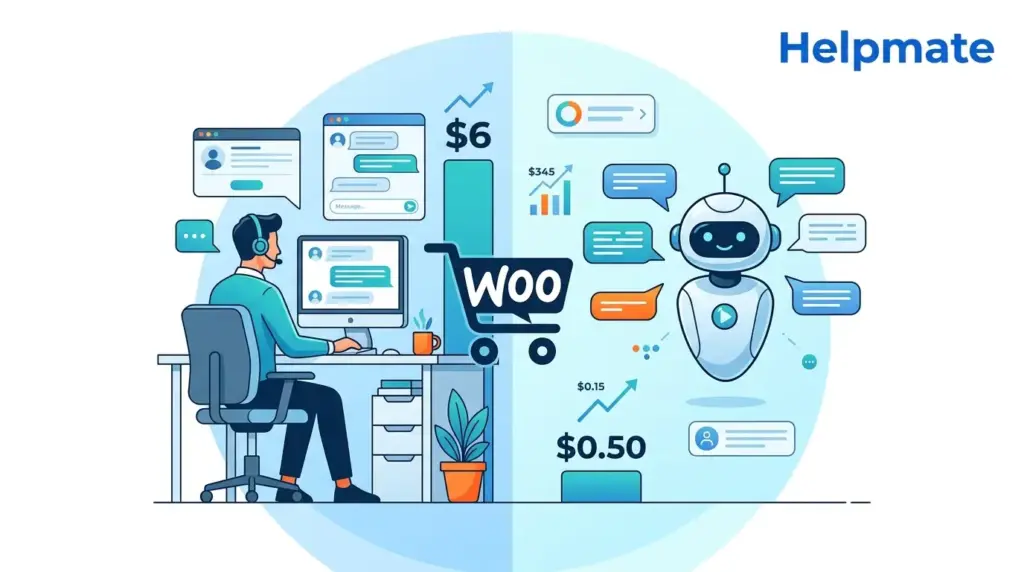
- Chatbot interactions run about $0.50 versus $6.00 for human agents—roughly a 12x gap based on ChatMaxima’s 2026 numbers. Most WooCommerce stores we see hit break-even somewhere between month three and six.
- AI chatbots can drop response times by up to 99% compared to manual support. We’re talking answers in 1-3 seconds instead of waiting hours (IBM Research via Crisp, 2026).
- About half of consumers—51% according to Zendesk’s 2026 data—actually prefer bots when they need something handled immediately.
- Companies are reporting around 340% ROI in year one on AI customer service investments (Crisp, 2026).
Running a WooCommerce store means constantly context-switching between inventory headaches, marketing campaigns, and the endless stream of customer questions. Every hour your team spends typing “Your order shipped three days ago” or “Yes, we have that in medium” is an hour they are not spending on anything that actually grows the business. The question stopped being whether you can afford AI chatbot automation. It became whether you can stomach the hidden costs of sticking with manual support.
What Is the True Cost Difference Between AI Chatbots and Human Agents?
Chatbot interactions cost approximately $0.50 on average, compared to $6.00 for human agent interactions—a 12x cost differential according to ChatMaxima’s 2026 analysis. But that gap widens once you factor in the stuff that does not show up on the per-ticket price: training, benefits, the whole management layer.
Take a typical WooCommerce store fielding 500 customer inquiries monthly. Manual support at $6 per interaction hits $3,000 monthly. An AI chatbot handling that same volume costs roughly $250. That $2,750 monthly difference—$33,000 annually—is money that could go toward inventory expansion, ad spend, or finally launching that product line you have been sitting on.
The cost comparison goes deeper than per-interaction pricing. Human agents need onboarding, ongoing training, benefits, management overhead. They work fixed hours, which creates coverage gaps during nights and weekends when a surprising chunk of e-commerce sales actually happen. AI chatbots just… run. No overtime, no sick days, no sudden departures that leave you scrambling.
Helpmate bridges this gap by offering both AI-powered chatbot automation and live chat capabilities in one unified system. The free version includes essential chatbot features, while the Pro version unlocks advanced automation, CRM integration, and unlimited team members for growing stores.
How Much Faster Can AI Chatbots Respond Compared to Manual Support?
IBM research shows AI chatbots can reduce average response times by up to 99% in scenarios where customers previously waited hours for human assistance, according to Crisp’s 2026 support benchmarks. While human agents typically take 5-30 minutes to respond—or hours during peak periods—AI chatbots deliver answers in 1-3 seconds.
This speed differential changes customer expectations in ways that are hard to ignore. When a shopper abandons their cart because they cannot get a quick answer about shipping costs, that revenue is gone. H&M’s generative AI chatbot reduced response times by 70% compared to human agents, which suggests enterprise retailers see speed as a conversion driver (ChatMaxima, 2026).
The psychology here is straightforward. 51% of consumers prefer interacting with bots over humans when they want immediate service, according to Zendesk’s 2026 research. They do not necessarily want to talk to a robot. They want their problem solved without the wait. The channel matters less than the outcome.
For WooCommerce stores, this translates to measurable impact. Customers who get instant answers about product availability, sizing, or return policies are significantly more likely to complete purchases. Those left waiting often just… browse elsewhere.
What ROI Should You Expect from AI Chatbot Investment?
Companies report an average 340% ROI in the first year on AI customer service investments, with $3.50 returned for every $1 spent, according to Crisp’s 2026 analysis. The return comes from multiple angles: reduced labor costs, better conversion rates from faster responses, and the ability to scale without hiring in lockstep.
The payback timeline varies by store size and inquiry volume. Smaller WooCommerce stores processing 100-200 monthly inquiries typically see break-even within 3-4 months. Mid-sized stores handling 1,000+ inquiries monthly often recover costs within 60-90 days due to the compounding effect of handling multiple conversations at once.
Chatbots can reduce customer support costs by up to 30% according to Envive AI’s 2026 analysis, with potential for higher savings when the AI handles routine inquiries while human agents focus on complex escalations. The key is implementation: actually training the chatbot on your specific products, policies, and common questions.
Support teams report an average daily time saving of 2 hours and 20 minutes using chatbots, with 84% saying it simplifies ticket response and 64% noting increased personalization capabilities (Master of Code, 2026). These time savings translate to either cost reduction or the ability to handle higher inquiry volumes without adding headcount.
Which Support Tasks Should AI Handle vs Human Agents?
Not every customer interaction belongs with a chatbot. The stores seeing the best results use AI for high-volume, routine stuff while keeping humans for complex, emotionally sensitive, or high-value situations. This hybrid approach seems to maximize both cost efficiency and customer satisfaction.
Ideal for AI Chatbot Automation
- Order status lookups and shipping tracking
- Product availability and sizing questions
- Return policy explanations and refund status checks
- Password resets and account access issues
- FAQ responses and standard troubleshooting
- Lead capture and qualification
Reserved for Human Agents
- Complex technical troubleshooting
- Complaint resolution and de-escalation
- Custom quote requests and bulk orders
- Payment disputes and fraud investigations
- VIP customer relationship management
62% of consumers prefer AI customer service over waiting for human agents when the AI can resolve their issue immediately, according to Envive AI’s 2025 research. The insight here is that channel preference depends entirely on resolution speed and accuracy. Customers get frustrated not because they are talking to a bot, but because the bot cannot help them.
Helpmate’s Knowledge Base allows you to train the AI chatbot on your specific WooCommerce products, policies, and content, ensuring accurate responses grounded in your actual business data rather than generic information.
How Does AI Chatbot Implementation Affect Team Productivity?
The productivity impact extends beyond cost savings to team morale and capability. Support agents who spend their days answering the same “Where is my order?” question experience higher burnout than those handling varied, challenging problems. AI chatbots eliminate the repetitive tedium while amplifying what humans do best.
Teams with AI assistance see the most significant gains in ticket throughput. One human agent might handle 20-30 concurrent chats with AI assistance versus 3-5 without. This multiplier effect means small teams can support growing customer bases without proportional hiring. For WooCommerce stores dealing with seasonal spikes during Black Friday or holiday periods, this elasticity is invaluable.
The data shows consistent patterns across industries. Teams using chatbots report simplified workflows (84%), increased personalization (64%), and substantial daily time savings averaging over 2 hours (Master of Code, 2026). These improvements compound over time as the AI learns from interactions.
Implementation quality determines results. A poorly trained chatbot that frequently escalates to human agents or provides wrong information creates more work, not less. Successful deployments invest in comprehensive training data: product catalogs, policy documents, FAQ libraries, and historical chat logs showing real customer questions and effective responses.
What Are the Hidden Costs of Relying Solely on Manual Support?
Direct labor costs represent only the visible portion of manual support expenses. The hidden costs—opportunity costs, customer churn, operational inflexibility—often exceed the obvious payroll line item. Understanding these less visible factors clarifies why AI chatbot adoption keeps accelerating.
Opportunity cost shows up as lost revenue. Every potential customer who abandons their cart or browses away because they could not get a quick answer represents foregone sales. Response time correlates directly with conversion rates. Stores with sub-30-second response times convert at significantly higher rates than those requiring hours.
Customer churn represents another hidden cost. Shoppers remember poor support experiences. They share them on social media and review platforms. For WooCommerce stores, where repeat customers often drive 40-60% of revenue, losing customers to support friction has compounding effects on lifetime value.
Operational inflexibility limits growth. Manual-only support creates a linear relationship between inquiry volume and headcount. Double your sales, double your support team. This model prevents small teams from handling growth spurts and creates coverage gaps during off-hours when international customers shop.
Helpmate addresses these challenges with unified inbox management, allowing you to handle chatbot conversations, social DMs, and tickets from WordPress, WhatsApp, Instagram, Facebook, and Messenger in one place without switching between platforms.
How Do You Calculate Total Cost of Ownership for AI Support?
Total cost of ownership (TCO) analysis moves beyond subscription pricing to include implementation, training, and ongoing optimization. For most WooCommerce stores, the TCO calculation favors AI chatbots, but understanding the complete picture prevents surprises.
AI Chatbot TCO Components
- Monthly platform subscription
- Initial setup and training data preparation
- Integration with WooCommerce and other tools
- Ongoing knowledge base maintenance
- Periodic review and optimization time
Manual Support TCO Components
- Agent salaries and benefits
- Recruiting and onboarding costs
- Training and quality assurance
- Management and oversight
- Desk space and equipment (for in-house teams)
- Turnover and replacement costs
The breakeven analysis is straightforward for most stores. If you are paying $3,000 monthly for a part-time support agent and can implement an AI chatbot solution for $300 monthly, your breakeven is immediate. Even accounting for setup time, the ROI becomes positive within the first billing cycle for stores with moderate inquiry volumes.
The Helpmate – Live, Social & AI Chat with Built-in CRM plugin offers a free version for stores wanting to test AI chatbot capabilities before upgrading to Pro features including advanced automations, CRM integrations, and unlimited conversations.
FAQ: AI Chatbot vs Manual Support Cost Analysis
Chatbot interactions cost approximately $0.50 on average, compared to $6.00 for human agent interactions. This 12x cost differential makes AI chatbots economically attractive for high-volume support scenarios. The per-interaction cost for chatbots remains relatively flat as volume increases, while human costs scale linearly with headcount.
Companies report an average 340% ROI in the first year on AI customer service investments, with $3.50 returned for every $1 spent according to Crisp’s 2026 research. Most WooCommerce stores achieve payback within 3-6 months depending on inquiry volume. Stores handling 500+ monthly inquiries typically see breakeven in 60-90 days.
AI chatbots respond in 1-3 seconds compared to 5-30 minutes for human agents, with IBM research showing up to 99% reduction in response time. H&M’s generative AI chatbot achieved a 70% reduction in response times compared to human agents. Speed directly correlates with customer satisfaction and conversion rates.
51% of consumers prefer interacting with bots over humans when they want immediate service according to Zendesk’s 2026 research. Customer preference depends on issue complexity and resolution speed rather than channel type. Shoppers prioritize getting the right answer quickly over whether a human or AI provides it.
Chatbots can reduce customer support costs by up to 30% according to Envive AI’s 2026 analysis. Support teams report an average daily time saving of 2 hours and 20 minutes using chatbots. Actual savings depend on implementation quality and the percentage of inquiries suitable for automated handling.
No. The most effective support strategies use AI for routine inquiries while reserving humans for complex, emotional, or high-value interactions. This hybrid approach maximizes cost efficiency without sacrificing customer satisfaction for situations requiring empathy, judgment, or creative problem-solving.
Effective AI chatbots require regular knowledge base updates as products, policies, and common questions change. Plan for monthly reviews of chatbot performance metrics, identification of questions the bot could not answer, and training on new content. Well-maintained chatbots improve over time; neglected ones degrade.
Key Takeaways: Making the Right Choice for Your Store
- AI chatbots cost roughly 12x less per interaction than human agents ($0.50 vs $6.00) while delivering 99% faster responses
- 340% average first-year ROI makes chatbot implementation a clear financial winner for most WooCommerce stores
- Hybrid strategies outperform all-or-nothing approaches. Use AI for routine inquiries, humans for complex situations
- Implementation quality matters more than raw technology. Invest in training data and ongoing optimization
- Hidden costs of manual support—lost sales from slow responses and customer churn—often exceed obvious payroll expenses
The decision between AI chatbot and manual support is not binary. Leading WooCommerce stores deploy both strategically, using automation where it excels and human judgment where it matters. Start by benchmarking your current response times and costs, then implement AI for your highest-volume, most routine inquiries. Measure results and expand automation based on performance data rather than assumptions.
If you are evaluating AI chatbot solutions for your WooCommerce store, begin with a solution that integrates natively with WordPress and WooCommerce. The cost savings from eliminating complex integrations often rival the chatbot subscription itself.
Ready to cut your support costs? Start your free Helpmate trial and see how AI automation transforms your WooCommerce store.