TL;DR: The average ecommerce cart abandonment rate hit 70.22% in 2026 (Baymard Institute). Recovery email sequences sent within 1 hour can reclaim 10-20% of lost carts. The most effective strategy combines three timed emails, personalized product images, and modest incentives like free shipping. For WordPress stores, integrating abandoned cart recovery with chatbot follow-ups via Helpmate – Live, Social & AI Chat with Built-in CRM creates a unified recovery system that captures more revenue than email alone.
Why Do Shoppers Abandon Carts in 2026?
Cart abandonment costs ecommerce merchants approximately $4.6 trillion in lost revenue annually (Dynamic Yield, 2025). If you’ve run a store for more than a few months, you’ve probably watched those numbers climb and wondered what went wrong. The primary reasons haven’t changed much: unexpected shipping costs (48%), account creation requirements (24%), and complicated checkout processes (22%) (Baymard Institute, 2026).
Mobile abandonment rates are particularly concerning. APAC regions show 80.82% abandonment, EMEA sits at 79.74%, while the Americas perform slightly better (Dynamic Yield, 2025). These statistics reveal a critical insight. Most abandonment is not intentional rejection. It is browsing behavior, price comparison, or interruption.
Recovery emails work because they address intent at the moment of highest interest. Shoppers who abandon carts have already invested time selecting products. They are warmer prospects than casual browsers. The strategy lies in timing, relevance, and reducing friction to complete purchase.
What Is the Average Abandoned Cart Recovery Rate?
Acceptable abandoned cart recovery rates range from 10% to 20% when using optimized email sequences (Sendtric, 2026). This means for every 100 abandoned carts, you should recover 10 to 20 completed purchases. Without any recovery system, natural return rates hover around 8% (VWO, 2026).
The gap between basic and optimized recovery is significant. Merchants using single-send blasts average 5% recovery. Those deploying three-email sequences with personalization see rates climb to 15% or higher. The difference compounds quickly. A store with 500 monthly abandoned carts moves from 25 recovered orders to 75 recovered orders. At $75 average order value, that is $3,750 in additional monthly revenue.
Industry benchmarks show open rates for abandoned cart emails averaging 45% compared to 21% for standard promotional emails (SaleCycle, 2025). Click-through rates hit 21% versus 3% for regular campaigns. These engagement metrics prove abandoned cart emails are not spam. They are anticipated follow-ups that shoppers expect and respond to.
When Should You Send Abandoned Cart Recovery Emails?
The first email should send within 1 hour of abandonment to capture peak purchase intent (MailMend, 2026). This timing is critical. Shoppers still have your store open in browser tabs. The products remain fresh in memory. Delay beyond 60 minutes and recovery probability drops 50%.
The optimal three-email sequence follows this timeline:
- Email 1: 30-60 minutes post-abandonment. Reminder only, no incentive.
- Email 2: 24 hours later. Social proof and urgency.
- Email 3: 72 hours later. Final attempt with modest incentive.
Each delay serves a purpose. The hour-one email catches distraction. The day-later email addresses comparison shopping. The three-day email overcomes price sensitivity. Sending beyond three emails risks unsubscribe rates climbing 3x while incremental recovery falls below 2%.
What Should Your First Abandoned Cart Email Include?
The first email functions as a helpful reminder, not a sales pitch. It should display the abandoned products with clear images, names, and prices. Include a prominent single-click return-to-cart button. Remove all barriers to completion.
Subject lines determine open rates. Effective formulas include: “You left something behind,” “Your cart is waiting,” or “Complete your order in one click.” Personalization lifts open rates 26% (SaleCycle, 2025). Use the shopper’s first name when available.
The email body should contain: product imagery at 600px width for mobile clarity, item specifications, cart total with shipping calculator link, and customer service contact options. Avoid discounts in the first email. Save incentives for the final email when price sensitivity is highest.
How Many Emails Should You Send in a Recovery Sequence?
Three emails represent the optimal balance between recovery and reputation. Sequences with 3-4 emails generate 69% more orders than single sends (Omnisend, 2025). However, extending to 5+ emails shows diminishing returns with unsubscribe rates spiking 340%.
| Sequence Length | Recovery Rate | Unsubscribe Rate |
|---|---|---|
| 1 email | 5-7% | 0.1% |
| 3 emails | 14-18% | 0.3% |
| 5+ emails | 16-19% | 1.2% |
The table reveals the inflection point. Three emails capture 80% of recoverable revenue while maintaining list health. Additional emails chase marginal gains at significant reputation cost. For most WooCommerce stores, the three-email sequence maximizes lifetime value.
How Can Personalization Improve Recovery Rates?
Personalized abandoned cart emails generate 20% more revenue than generic templates (Dynamic Yield, 2025). Effective personalization extends beyond first name insertion. It includes browse history recommendations, dynamic product imagery, and localized currency display.
Product recommendations based on cart contents lift click-through rates 35%. If a shopper abandons running shoes, suggesting complementary socks or fitness trackers creates relevance. This cross-sell approach recovers the original cart while increasing average order value 12%.
Behavioral triggers add sophistication. Segment abandonment by cart value. High-value carts ($200+) receive priority support offers. Low-value carts ($25-) receive free shipping incentives. Time-based personalization adjusts send times to recipient time zones, improving open rates 8%.
What Role Do Incentives Play in Cart Recovery?
Strategic incentives recover 15% of otherwise lost carts, but premature discounting erodes margins. The key is sequencing. Reserve explicit discounts for the final email after reminder and social proof attempts have failed.
Effective incentive structures include:
- Free shipping: Most effective for carts under $75 threshold
- Percentage discounts: 10-15% for carts over $150
- Fixed amount: $10 off for carts between $50-100
- Time limits: 24-hour expiration creates urgency
Free shipping outperforms percentage discounts by 25% in A/B testing (Contentsquare, 2025). Shoppers perceive shipping costs as unfair fees rather than purchase components. Removing this friction feels like service improvement rather than price cutting.
How Can Chatbots Complement Email Recovery?
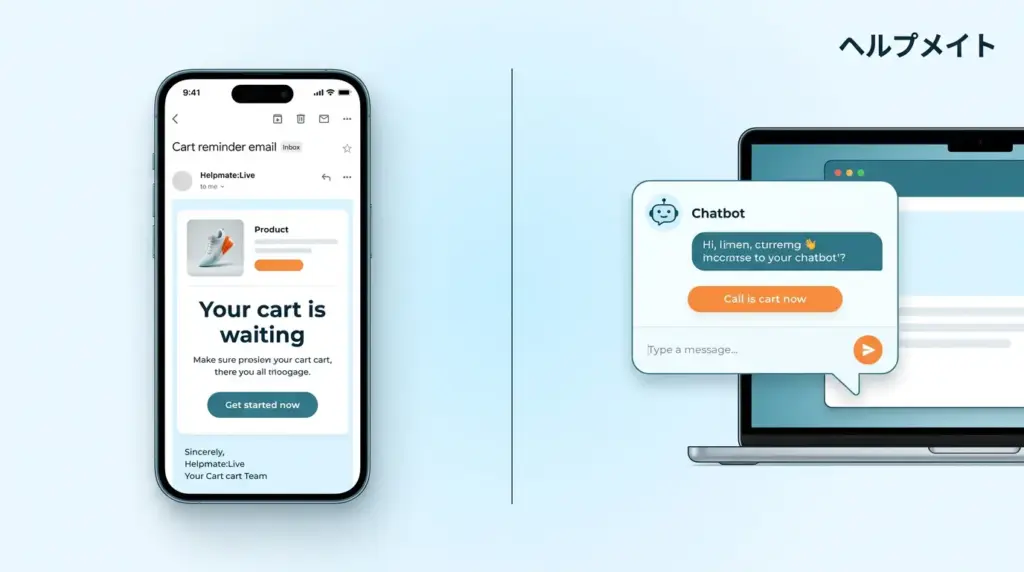
Email and chatbot coordination creates omnichannel recovery that outperforms single-channel approaches by 23% (AirOps, 2025). When shoppers open abandoned cart emails on mobile devices, retargeting via Messenger or WhatsApp captures attention that inbox saturation has lost.
The integration workflow functions as follows: cart abandonment triggers email sequence start. After email two, non-converters enter chatbot outreach queue. The chatbot sends personalized message: “Hi [Name], I noticed you were looking at [Product]. Questions I can answer?” This conversational approach addresses the 35% of abandoners who needed assistance rather than motivation.
Helpmate – Live, Social & AI Chat with Built-in CRM unifies this workflow. Abandoned cart data flows from WooCommerce into the CRM. Email sequences trigger via the abandoned cart module. Simultaneously, chatbot conversations can reference cart contents for contextual support. The unified inbox shows complete customer journey: email opens, site visits, and chat interactions.
FAQ
A good abandoned cart recovery rate ranges from 10% to 20% (Sendtric, 2026). This means recovering 10 to 20 carts for every 100 abandonments. Rates below 10% suggest email timing or messaging issues. Rates above 20% indicate strong segmentation and incentive strategy.
Send the first abandoned cart email within 30 to 60 minutes of abandonment (MailMend, 2026). This window captures shoppers while purchase intent remains high. Delay beyond one hour and recovery probability drops by approximately 50%.
Reserve discounts for the final email in your sequence. Leading with incentives trains customers to abandon intentionally. Free shipping outperforms percentage discounts by 25% (Contentsquare, 2025) and preserves margin better than 10-15% off offers.
Helpmate’s Abandoned Cart module integrates with WooCommerce to trigger automated email sequences when carts are abandoned. The system captures cart contents, customer data, and abandonment time. Recovery emails are customizable and include one-click return links. The CRM tracks recovery success and enables chatbot follow-up for non-responders.
The global cart abandonment rate reached 70.22% in 2026 according to Baymard Institute research. This represents an increase from 69.8% in 2024. Mobile abandonment rates are highest at 80.82% in APAC regions, while desktop abandonment averages 65%.
Three emails maximize recovery while preserving subscriber relationships. Sequences with 3 emails generate 69% more orders than single sends (Omnisend, 2025). Extending to 5+ emails increases recovery only marginally while unsubscribes spike 340%.
Omnichannel recovery combining email and chatbots outperforms email-only approaches by 23% (AirOps, 2025). Chatbots address the 35% of abandoners who needed assistance rather than motivation. Conversational follow-ups via Messenger or WhatsApp capture attention that saturated inboxes have lost.
Conclusion
Abandoned cart recovery represents the highest-ROI marketing activity for ecommerce stores. With 70.22% of carts abandoned globally, the revenue opportunity exceeds immediate acquisition costs. The strategy is straightforward: send three timed emails, personalize with product imagery, reserve incentives for final attempts, and layer chatbot follow-up for omnichannel reach.
Key takeaways:
- Target 10-20% recovery rates with optimized sequences
- Send first email within 60 minutes while intent is fresh
- Use three emails maximum to balance recovery and list health
- Personalize beyond names with product recommendations
- Integrate chatbot follow-up for omnichannel reach
For WordPress stores, Helpmate – Live, Social & AI Chat with Built-in CRM provides the infrastructure to implement these strategies without complex integrations. The abandoned cart module, unified CRM, and chatbot capabilities create a recovery system that captures revenue currently leaking from your checkout process.
Ready to boost your recovery rates? Explore Helpmate’s e-commerce AI tools and start converting abandoned carts into sales today.