
TL;DR
E-commerce merchants typically lose somewhere around 15-25% of annual revenue to refunds and chargebacks. AI support systems that actually answer questions immediately, explain policies clearly, and check in proactively after orders can reduce refund requests by roughly 30% and cut chargeback disputes significantly.
Marketing teams celebrate conversion rates while support teams quietly drown in return labels and chargeback notifications. That’s the reality most e-commerce operators live with. Those post-purchase problems don’t just nibble at margins—they chew through time, wreck brand reputation, and in bad cases, get your merchant account flagged or suspended.
Most refunds and chargebacks don’t start with defective products or fraud. They start with confusion. A customer can’t figure out if that lamp fits their desk, can’t get an answer about sizing, or doesn’t understand when their order will actually show up. When people feel stuck or ignored, they reach for the only option they think they have: demanding their money back through whatever channel works fastest.
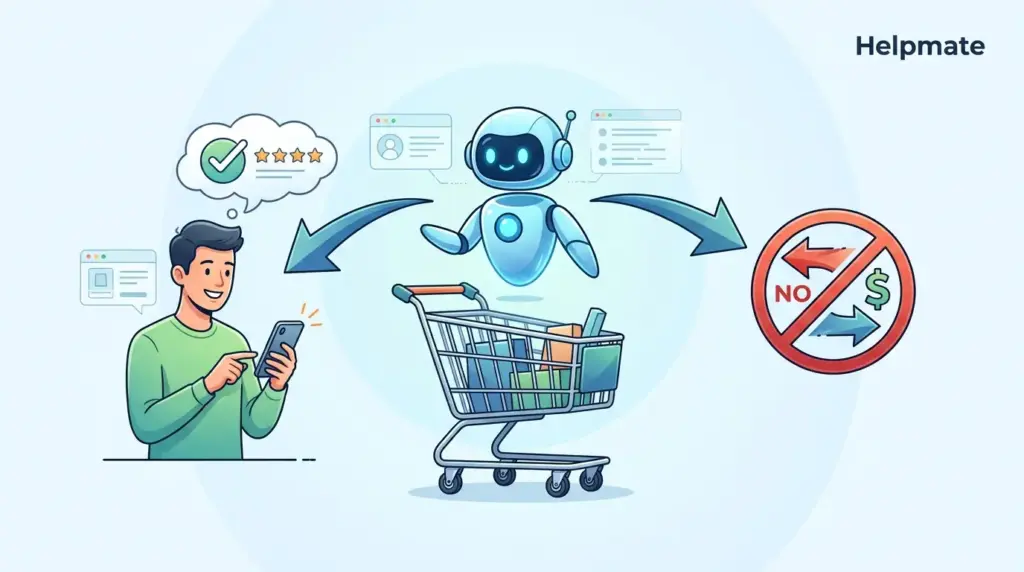
This is where AI-powered customer support shifts from “nice-to-have” to actual business protection. Instant answers at the right moments eliminate the frustration that drives disputes. Below, we’ll look at what chargebacks really cost, how proactive AI support catches problems early, and practical ways to implement this without overengineering everything at once.
Why Refunds and Chargebacks Hurt More Than You Think
Refund rates typically sit between 15% and 25% depending on what you sell. Apparel gets hit hardest—some fashion retailers see 40% of orders come back. Electronics and home goods usually land in the 10% to 15% range. Digital products and consumables fare better, but even 5% adds up fast when you’re processing volume.
The direct costs extend past the transaction amount. You eat shipping both ways, pay warehouse staff to process returns, and often can’t resell the item as new. For a $100 order, you’re frequently looking at $130 to $150 in total cost after shipping, handling, and marking down returned inventory.
Citation Capsule: The True Cost of Refunds
Research from Invesp shows that for every $100 in returned merchandise, online retailers lose an average of $110 when accounting for shipping, processing, and inventory write-downs. The cumulative impact means a business processing $1 million in annual sales with a 20% refund rate effectively loses $220,000 annually just to returns, not counting lost customer lifetime value or acquisition cost waste.
Chargebacks hit even harder. When customers bypass you entirely and dispute charges through their credit card company, you’re looking at $20 to $100 in fees per incident—win or lose. Processors watch your chargeback ratio like hawks. Cross 1% and you’re in high-risk territory, facing higher processing fees, forced reserves, or sudden account termination.
Then there’s the reputational damage. Customers who chargeback rarely return, and they tell their friends. One preventable dispute can cost you not just the transaction and fees, but potentially thousands in future revenue from that customer and their network.
The Costs Nobody Calculates
Most merchants forget about wasted acquisition costs. If you spent $40 on ads to acquire a customer who immediately returns their purchase, that $40 is pure loss with zero return. You’re literally paying to ship headaches to your warehouse.
Citation Capsule: Acquisition Cost Waste
When a customer acquired through paid advertising immediately requests a refund, the entire customer acquisition cost becomes sunk waste. For businesses with typical e-commerce CAC of $30-50, this represents additional unmeasured losses on top of direct refund processing costs.
Timing matters too. Late-night impulse purchases—those 2 AM shopping sessions—show higher return rates. So do panic buys during flash sales when customers don’t have time to think. AI chatbots that engage during these specific high-risk windows, confirming product details before checkout, can prevent a surprising number of subsequent refunds.
How Communication Gaps Create Refunds
The vast majority of returns stem from misunderstandings, not defective products. When customers can’t get clear answers about sizing, compatibility, shipping times, or return policies before ordering, they buy based on assumptions. When those assumptions prove wrong, they feel misled.
Citation Capsule: The Root Cause Pattern
Studies by customer experience research firms consistently show that over 70% of returns are attributed to factors within merchant control: product description clarity, sizing accuracy, shipping expectation communication, and policy transparency. Only a minority of refunds reflect actual product quality failures.
Here’s a pattern I see constantly. Someone wants to know if a lamp fits their specific table. The product page lists dimensions but doesn’t address their use case. They hunt for contact info, find an email form promising “24-48 hour responses,” and order anyway hoping for the best. The lamp arrives. It doesn’t fit. Rather than deal with return shipping, they file a chargeback because they feel the company wasted their time.
This plays out thousands of times daily. The customer had a simple question. Traditional support couldn’t respond fast enough. The disappointment became a chargeback because they felt blindsided.
The Critical Timing Windows
Citation Capsule: Support Response Expectations
Consumer research shows 82% of customers expect immediate responses to sales questions, with defined “immediate” as under 10 minutes. When pre-purchase questions go unanswered for hours, potential buyers either abandon carts or make uninformed purchases that become refund risks.
The post-delivery period is equally critical. When orders arrive, customers immediately evaluate whether expectations matched reality. If the product differs from what they pictured, or if setup proves confusing, the first 24 hours determine whether they seek help or initiate returns. Merchants who provide clear instructions, proactive delivery updates, and immediate support during this window can resolve confusion before it becomes a dispute.
Why Customers Choose Chargebacks Over Returns
Citation Capsule: The Emotional Chargeback Trigger
Customer psychology research reveals that chargeback decisions are driven more by emotional responses to poor service than objective product inadequacy. When customers feel ignored, misled, or disrespected during support interactions, they choose chargebacks as a form of retaliation against merchants they perceive as unresponsive or uncaring.
Chargebacks often serve as revenge. When customers feel dismissed or ignored by support, they escalate to their credit card company as punishment. AI chatbots that provide immediate acknowledgment and helpful responses short-circuit this emotional pathway before it reaches the “screw this company” stage.
Preventing Refunds Before They Happen
The best refund prevention happens before checkout. When customers get instant, accurate information during their decision process, they make choices that align with their actual needs. This eliminates the expectation mismatches driving most returns.
Citation Capsule: AI Impact on Pre-Purchase Confidence
Research from conversational commerce platforms shows that e-commerce sites deploying AI chatbots see 20-30% reductions in return rates compared to similar sites relying on traditional contact forms and delayed email responses. The correlation between instant answer availability and informed purchase decisions directly impacts refund volume.
AI chatbots engage customers during browsing to answer specific questions static pages can’t handle. Someone wondering if a laptop runs specific software gets immediate confirmation rather than hunting through spec sheets. Shoppers worried about clothing fit get detailed comparisons rather than guessing from generic charts. These micro-interactions prevent the uncertainty that leads to refunds.
Spotting At-Risk Customers
Sophisticated AI systems can identify customers at elevated refund risk and intervene proactively. Behavioral signals—rapid page switching between similar products, extended time on return policy pages, cart abandonment followed by return visits—all indicate uncertainty that precedes refund requests.
Citation Capsule: At-Risk Customer Signals
Behavioral analytics identify key refund risk indicators: customers who view return policies multiple times, switch between product variants repeatedly, or abandon carts multiple times before purchase. Targeted AI interventions during these moments significantly reduce subsequent refund rates.
AI chatbots can ask clarifying questions during complex purchases. When a customer views multiple sizes of the same product, the bot might ask about intended fit preferences or provide specific measurements. This proactive guidance prevents size-related returns—the largest category in apparel and fashion.
If you’re looking for a solution that combines AI chatbot capabilities with comprehensive support features, check out Helpmate – Live, Social & AI Chat with Built-in CRM. It provides instant responses across your website and social channels, helping prevent the communication gaps that lead to refunds.
Post-Purchase Communication That Actually Works
The gap between order placement and delivery represents a critical vulnerability. Customers experiencing anxiety, confusion, or buyer’s remorse during this phase often initiate returns before products even arrive. Proactive communication—confirming order details, providing shipping transparency, setting clear expectations—significantly reduces post-purchase regret.
Citation Capsule: The Shipping Communication Gap
Research consistently shows that unclear delivery expectations rank among the top three reasons for e-commerce refunds. When customers don’t understand when orders will arrive or cannot easily track shipments, they perceive the merchant as unreliable and initiate returns out of frustration rather than product dissatisfaction.
AI systems excel at delivering consistent, timely updates without manual work. Order confirmations clarify exactly what was purchased and when it ships. Shipping notifications provide regular updates that reduce anxiety. Delivery confirmations trigger follow-up messages offering setup assistance before problems escalate to return requests.
The unboxing experience represents a final opportunity to prevent refunds. Products requiring assembly, configuration, or specific usage often generate returns when customers can’t immediately figure them out. Providing setup instructions, tutorial links, or troubleshooting guidance before customers hit problems prevents the frustration driving refund requests.
Citation Capsule: High-Impact Post-Purchase Communication
- Immediate order confirmation with clear delivery expectations
- Proactive shipping notifications with tracking details
- Setup and usage guidance delivered with unboxing instructions
- Return policy explanation before delivery arrival
- Immediate support availability for delivery questions
How Clear Return Policies Prevent Chargebacks
The relationship between return policy visibility and chargeback rates is direct. When customers understand return procedures and trust you’ll honor reasonable requests, they use your return channel rather than disputing charges through their card issuer. The key is making policies discoverable and fair before purchase decisions.
Citation Capsule: Policy Transparency Impact
Industry analysis shows that merchants with prominent, clearly explained return policies experience chargeback rates 40% lower than competitors with hidden or confusing policy language. The psychological principle is straightforward: customers who trust the merchant’s fairness don’t need to escalate to their card issuer.
What Trust-Building Policy Communication Looks Like
Citation Capsule: Policy Communication Checklist
- Clear timeframes for returns, exchanges, and refunds
- Condition requirements for returned items
- Refund method expectations and processing times
- Shipping cost responsibility for returns
- Exception events that qualify for special handling
AI systems trained on policy documents can answer nuanced questions without escalating to human agents. When a customer asks, “I bought this three weeks ago but just opened it—can I still return?” the chatbot provides the specific answer rather than forcing them to assume they can’t return and file a chargeback instead. This availability prevents customers from assuming the worst and escalating unnecessarily.
Practical AI Strategies for Refund Prevention
Citation Capsule: AI Support ROI
Organizations implementing comprehensive AI support systems report average refund rate reductions of 25-35%, with chargeback reductions of similar magnitude. The combined impact on profit margins often justifies AI implementation costs within the first quarter of deployment.
If you’re ready to implement AI support, Helpmate – Live, Social & AI Chat with Built-in CRM offers a robust solution for WordPress sites. It combines website chat, social messaging, and AI-powered responses to ensure customers get instant answers throughout their journey.
Implementation works best phased rather than attempting to automate everything simultaneously. Start with the highest-impact use cases, then build out.
Citation Capsule: Tiered AI Support Implementation
- Phase 1: Deploy pre-purchase Q&A for top 10 customer questions
- Phase 2: Add order tracking and shipping notifications
- Phase 3: Implement return policy chatbot for instant clarification
- Phase 4: Integrate behavioral signals for proactive outreach
Your specific priorities depend on product category and current refund patterns. Apparel retailers should prioritize sizing questions. Electronics sellers benefit from compatibility verification. Home goods merchants see impact from dimension clarification. Understanding your specific refund drivers allows targeted AI deployment addressing root causes.
Conclusion
Refunds and chargebacks represent preventable revenue losses for most e-commerce operations. The root causes—unclear product information, delayed support responses, confusing policies, post-purchase communication gaps—are addressable through strategic AI implementation. Instant answers to pre-purchase questions, proactive order updates, and clear policy explanations eliminate the confusion driving customers to seek their money back.
The business case extends beyond customer convenience. Typical implementations deliver 25-35% reductions in refund rates with significant chargeback decreases, often justifying investment within the first quarter. Reducing disputes protects merchant account standing and preserves customer relationships driving long-term revenue.
Start by identifying your highest-volume customer questions and implementing AI responses addressing them instantly. Build toward proactive engagement identifying at-risk customers before they initiate returns. Merchants treating AI support as risk management investment rather than cost center protect margins while competitors absorb preventable losses.