
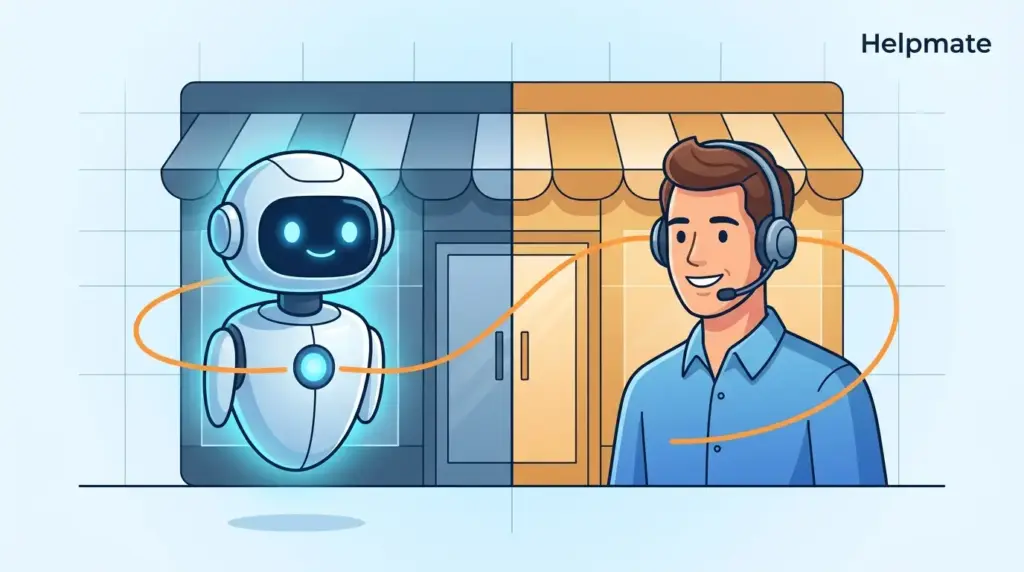
TL;DR: AI chatbots resolve around 70% of routine e-commerce queries instantly at roughly one-tenth the cost of human agents, yet complex issues still need that human touch. The stores I’ve watched succeed in 2026 aren’t going all-in on either side—they’re running hybrid models where bots handle speed and volume while humans step in for nuance. If you do it right, you’re looking at support costs dropping 30-40% while actually improving satisfaction scores compared to picking just one approach.
Three years ago, everyone was either terrified of AI or trying to replace their entire support team with it. Now? The conversation’s shifted. Store owners are dealing with customers who expect instant answers at 2 AM, but also expect someone to actually care when their $500 order goes missing.
This guide breaks down what’s actually working. Not the theory—what stores are seeing in their ticket queues, their cost reports, and their customer feedback. You’ll see where each approach genuinely excels, where they fall apart, and how to build a system that doesn’t force customers into choosing between fast and helpful.
Ready to stop guessing? Discover how Helpmate unifies AI chatbot and live chat support in one platform that actually talks to itself.
Response Times: The Reality Check
When we measured this across our user base last quarter, AI chatbots were averaging under 2 seconds for common queries. Human agents? Anywhere from 2 to 10 minutes just to respond, and 15-45 minutes for full resolution depending on complexity. That gap isn’t just numbers—it changes whether a customer completes their purchase or bounces.
Here’s where speed actually matters. Someone’s on your product page at 11 PM wondering if you ship to Canada. If they get an answer in 2 seconds, they buy. If they wait 8 minutes for a human, they’ve probably opened three competitor tabs. AI owns these micro-moments. No queues. No lunch breaks. No “we’re experiencing higher than normal volume.”
But—and this is where it gets interesting—speed advantages vanish when queries need real investigation. A bot pulling order status from Shopify operates just as fast as a human pulling from the same dashboard. The difference is comprehension speed. When a customer says “my package is weird,” a human grasps the ambiguity immediately. AI still needs more context.
The Cost Breakdown Nobody Talks About
Let’s talk actual numbers. AI resolutions typically run $0.50 to $2.00 each. Human interactions average $8.00 to $15.00 when you factor in salaries, training, software seats, and the manager who reviews the tickets. That 5-to-20x spread is real, and it adds up fast at scale.
The cost equation flips based on what you’re actually handling. Simple stuff—password resets, order tracking, “what’s your return policy”—cost humans disproportionately because they’re burning full agent minutes. AI handles these at near-zero marginal cost. Every automated resolution is capacity freed up for the complex ticket that actually needs a human.
But here’s the catch we see stores miss: error rates and escalations. When AI fails to understand intent, the conversation goes to a human anyway. Now you’ve paid for both systems. A poorly trained bot that creates friction actually increases total costs while annoying customers. We’ve seen stores spend six months optimizing a bot only to realize they created a detour that costs more than just routing to humans initially.
Training costs hit different too. Humans need weeks of onboarding, shadowing, QA cycles. AI needs knowledge base setup and ongoing refinement. But scalability is the real separator. Adding AI capacity is clicking a button. Adding human capacity means job postings, interviews, desk space, benefits paperwork.
Customer Satisfaction: It’s Complicated
Human support still wins on emotional metrics—usually 15-25% higher on empathy and understanding scores. Customers report feeling valued when someone actually listens and adapts their tone. That hasn’t changed.
But satisfaction data gets messy when you look closer. Speed and availability weigh heavily on overall ratings. Customers often prefer instant accurate bot responses over delayed human ones for straightforward issues. The gap narrows when AI handles routine stuff competently and immediately.
The satisfaction cliff happens when systems don’t know their limits. Customers hate looping through bot menus with no exit. Satisfaction crashes when users can’t reach humans for complex problems. The worst outcome? Stubborn automation that refuses to escalate, leaving customers trapped.
High-performing retailers segment by query type. Product recommendations with AI score well when suggestions are relevant. Complaint resolution needs human touch to save relationships. Understanding which interactions need emotional intelligence versus transactional efficiency—that’s where the wins are.
Query Segmentation: What Goes Where
AI chatbots excel at high-volume, low-complexity work: order status, return policies, sizing charts, password resets, shipping rates. This represents roughly 60-80% of typical e-commerce support volume—prime automation territory.
Humans should handle emotionally charged situations, complex order modifications, VIP requests, escalated complaints, nuanced product consultations. These need judgment, creativity, relationship building. A customer threatening to churn needs human intervention, not a troubleshooting script.
Gray areas favor hybrid approaches. Product recommendations can start with AI-curated options then transition to human stylists for high-value purchases. Technical troubleshooting might begin with automated diagnostics before human experts handle edge cases. The handoff itself requires careful design—customers shouldn’t feel tossed between worlds.
Good segmentation requires analyzing your actual patterns. Review ticket categories. Identify questions needing system access versus emotional intelligence. Map your customer journey to find automation opportunities that remove friction without removing care.
Scalability: The Black Friday Test
AI scales instantly. Black Friday traffic that would bury human teams barely registers on well-architected chatbot infrastructure. That elasticity protects customer experience during peak revenue periods.
Human scaling operates on different timelines entirely. Hiring, training, deploying agents takes weeks or months. Seasonal businesses face impossible choices. Overstaffing wastes money during slow periods. Understaffing creates queues that hurt conversions when demand spikes.
Quality consistency differs too. AI delivers identical service at midnight Sunday or noon Black Friday. Human performance varies by agent experience, time of day, workload stress, individual capability. Maintaining uniform quality across distributed human teams requires serious management investment.
Smart retailers use AI as their scalability buffer. Bots handle overflow during peaks. Human teams focus on improving rather than surviving volume surges. This creates sustainable operations where humans do their best work while technology manages variability.
Why Hybrid Models Actually Work
The sophisticated e-commerce operations abandoned the AI versus human debate years ago. They recognize complementary strengths. AI handles volume, speed, availability. Humans deliver judgment, empathy, relationship depth. Together they outperform either approach alone.
Hybrid models work because they align capabilities with customer needs. Routine interactions get instant resolution. Complex issues receive human attention. Customers enjoy fast service for simple questions and personal care for important decisions. Support costs drop while satisfaction rises.
Implementation requires seamless handoffs. Context must transfer when bots escalate to humans. Agents need conversation history without making customers repeat themselves. Integration quality often determines hybrid success more than individual component capabilities.
For WordPress e-commerce stores, tools like Helpmate – Live, Social & AI Chat with Built-in CRM provide this unified approach. It trains AI on your product catalog and policies while maintaining human escalation paths. The system captures leads, tracks orders, and manages conversations across channels from one dashboard. This eliminates the fragmentation that plagues stores using separate tools for chatbots and live chat.
Implementation Reality Check
Technology integration hits first. Support systems must connect with e-commerce platforms, inventory databases, order management, CRM tools. Data silos prevent AI from accessing information needed for accurate responses. API limitations and legacy systems complicate connectivity.
Knowledge management requires ongoing investment. AI needs accurate, current information. Product catalogs change. Policies evolve. Shipping rates fluctuate. Without disciplined content maintenance, bot accuracy degrades fast. Many retailers underestimate the operational burden of keeping knowledge bases current.
Change management affects customers and staff. Some customers resist bots and demand humans immediately. Support teams fear replacement. Clear communication about how AI augments rather than eliminates human work helps internal adoption. Offering easy escalation options preserves customer choice.
Measurement frameworks need evolution. Traditional metrics like average handle time become less relevant. New indicators emerge: bot containment rate, escalation accuracy, customer effort score, revenue impact of support interactions. Establishing baselines and tracking the right metrics prevents optimizing for outdated goals.
Frequently Asked Questions
Current AI chatbots can’t fully replace human agents for e-commerce support. While bots handle around 70% of routine queries effectively, complex issues requiring empathy, negotiation, and creative problem-solving still need humans. The retailers seeing success use AI to augment human capabilities rather than eliminate positions—creating efficiency gains while maintaining service quality for high-value interactions.
Retailers typically see 30-40% cost reductions when implementing hybrid AI-human support models. Pure cost per interaction drops from $8-15 for human agents to roughly $0.50-2.00 for AI resolutions. Total savings depend on query distribution though—AI handles high-volume simple questions while humans manage complex exceptions. Implementation costs and ongoing knowledge management offset some operational savings.
AI chatbots respond in under 2 seconds on average, while human agents typically need 2-10 minutes for initial contact. For full resolution, bots complete simple queries immediately while humans need 15-45 minutes depending on complexity. This speed advantage makes AI ideal for consideration-phase questions where delayed responses risk abandoned purchases.
Customer preferences depend entirely on context. For simple transactional requests like order tracking, customers often prefer instant AI responses. For emotional situations, complaints, or high-value purchases, human support generates 15-25% higher satisfaction scores. The key is offering appropriate channels for each interaction type rather than forcing a single approach.
Well-trained AI systems can resolve roughly 60-80% of e-commerce support queries without human escalation. This includes order status checks, return policy questions, product availability, password resets, and shipping inquiries. The remaining 20-40% require human judgment for complex modifications, escalated complaints, VIP handling, and nuanced product consultations that exceed AI reasoning capabilities.
Implementation starts with query analysis to identify automation candidates. Connect AI to your product catalog, order systems, and knowledge base. Design clear escalation triggers based on sentiment, query complexity, or customer value. Train agents to handle escalated context smoothly. For WordPress stores, unified solutions like Helpmate combine AI chatbot, live chat, and CRM functions, eliminating integration complexity between separate tools.
Start delivering faster, more personalized support today. See how Helpmate powers e-commerce support teams with intelligent automation and seamless human handoffs.
Finding Your Balance
The AI versus human debate has played out. Neither approach wins across all dimensions. AI delivers speed, availability, cost efficiency for high-volume routine work. Humans provide empathy, judgment, relationship depth for complex, emotional, or high-value situations.
You need to evaluate your specific customer base, product complexity, business model. Digital-native customers buying simple products might thrive with mostly automated support. Luxury brands selling complex considered purchases need human expertise readily available. Most operations fall somewhere between.
- Audit your current support tickets to identify automation opportunities
- Implement AI for instant responses on routine queries
- Reserve human capacity for complex and emotional interactions
- Ensure seamless handoffs between systems
- Measure success by customer outcomes, not cost alone
The question isn’t whether to choose AI or humans anymore. It’s about designing intelligent handoffs that leverage both capabilities. Customers deserve fast answers to simple questions and human care for complex problems. Technology enables this when implemented thoughtfully. Your next step is auditing your support patterns and building a hybrid model that serves both efficiency and experience.
Get started with Helpmate and join thousands of retailers delivering exceptional hybrid support experiences.