
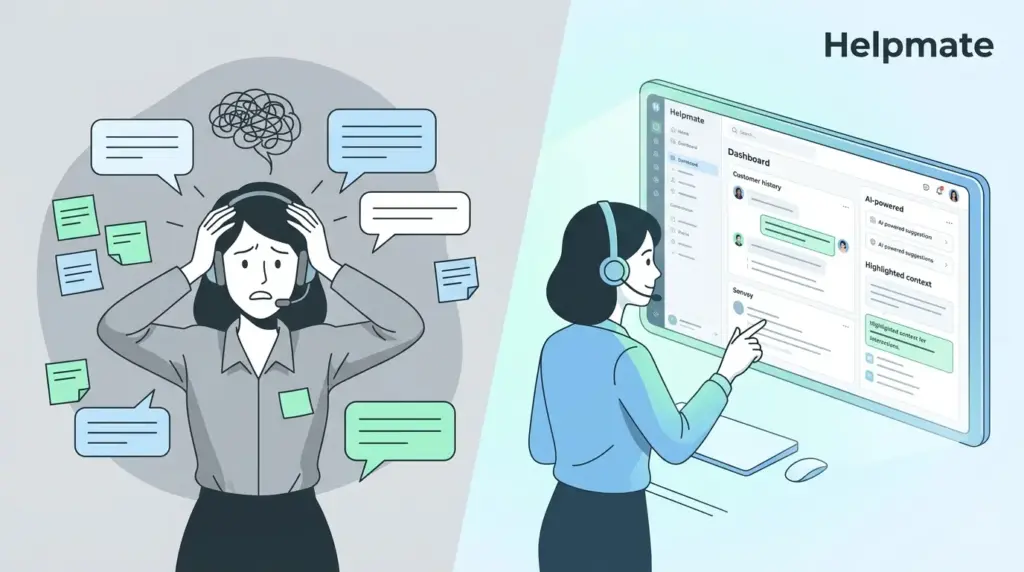
TL;DR: Tribal knowledge creates a 3-6 month onboarding bottleneck for support teams. Something like two-thirds of agents will tell you that critical resolution steps only exist in coworkers’ heads. Teams that move away from memory-dependent training toward context-visible systems typically see onboarding time drop by about half, plus better first-contact resolution. The real shift? Moving from “ask Sarah” workflows to embedded, AI-accessible knowledge that doesn’t require senior agents to hold everyone’s hand.
Your best support agent just quit. Three years of customer context, product quirks, and escalation patterns walked out the door. Now your newest hire is in Slack asking “how do I handle this refund edge case?” for the fourth time today. This is the tribal knowledge trap. It is quietly strangling support team scalability at thousands of companies.
The conventional approach to training new support staff leans heavily on shadowing sessions, PDF handbooks that go stale, and an unspoken rule: “When you’re stuck, ask someone who’s been here longer.” This model worked when teams were small and products were simple. It collapses under modern commerce complexity, multi-channel support, and the expectation of instant, accurate responses.
This article looks at why tribal knowledge fails at scale, what replaces it, and how context visibility transforms support training from a transfer of memory into something system-driven. The goal is not to eliminate human expertise but to make that expertise accessible, searchable, and scalable without burning out your veterans or leaving new hires guessing.
Why Does Tribal Knowledge Break Down as Teams Scale?
Support teams under 10 people often run on invisible infrastructure. Sarah knows which customers need VIP handling. Marcus understands the refund workaround for legacy plan users. This knowledge never got documented because, in a small team, everyone simply remembers who knows what. Past 15-20 agents, this model fractures.
The mathematics of scale work against tribal knowledge. In a 5-person team, there are 10 possible one-to-one knowledge relationships. In a 25-person team, there are 300. Each new hire must now navigate a labyrinth: ask this person for shipping issues, that person for billing, but only before 2 PM because they’re in Europe. The cognitive load compounds until your senior agents spend 30-40% of their time answering peer questions instead of customer tickets.
Tribal knowledge also creates single points of failure. When your documentation exists primarily in human memory, attrition becomes an existential risk. A support team that loses two senior agents in one quarter doesn’t just lose capacity. It loses institutional memory that takes 6-12 months to rebuild. That’s assuming you can hire replacements at all in a market where roughly three-quarters of support leaders report difficulty filling open roles.
The cost extends beyond training. New agents trained through tribal knowledge develop inconsistent patterns. They pick up the habits of whoever trained them, including workarounds that may no longer apply, tone mismatches with brand guidelines, and escalation triggers that vary by mentor. Standardization becomes impossible when your training system is essentially randomized by assignment.
What Is Context Visibility in Support Training?
Context visibility is the principle that every customer interaction should carry its own history, and that history should be accessible without asking. Rather than training agents to remember customer types, product versions, and previous issues, you architect systems that surface this context automatically at the moment of interaction.
The core components include unified conversation history across channels, integrated order and customer data, previous ticket patterns, and AI-suggested responses based on similar past resolutions. When an agent opens a chat, they see not just the current message but the customer’s lifetime value, last purchase, previous complaints, and whether they’ve been offered a discount before. This visibility eliminates the need for agents to memorize customer segments or dig through three systems to understand context.
Context visibility differs from traditional knowledge bases. A knowledge base requires agents to leave their workflow, search for information, and interpret relevance. Context visibility pushes information into the workflow at decision points. The training shift is profound: instead of teaching agents what to remember, you teach them how to read and act on surfaced context.
Teams implementing context visibility report that new agents reach proficiency 40-60% faster than those trained on tribal knowledge models. The acceleration comes from reducing cognitive load. Agents don’t waste mental energy memorizing customer tiers or product exceptions. They focus on judgment, empathy, and problem-solving with relevant data presented automatically.
How Do Built-in Processes Replace Memorization?
Built-in processes are decision architectures embedded directly into the support workflow. Rather than training agents to follow complex decision trees from memory, you codify those trees into the tools themselves. The system guides the agent through next steps based on customer inputs, automatically applying business rules that previously required veteran judgment.
Consider the refund process. Tribal knowledge training teaches agents which refund requests require manager approval, how to spot serial refunders, and when to offer store credit instead. Built-in process training configures these rules into the system itself. The agent sees a guided workflow: “Customer requests refund → Order within 30 days? Yes → Previous refunds this quarter? No → Approve with one click.” Edge cases still escalate to humans, but 70-80% of routine decisions no longer depend on agent memory.
The scalability advantage is immediate. When you update a return policy, you change one configuration instead of retraining 25 agents. When you identify a new fraud pattern, you add a detection rule instead of hoping everyone remembers the warning signs. The knowledge lives in the system, not in distributed human memory that degrades and disappears.
This approach also improves quality consistency. Human memory varies by day, workload, and individual. System rules apply uniformly. Customers get the same answer regardless of which agent they reach, eliminating the “I talked to someone else who said something different” frustration that damages trust and increases ticket volume through repeat contacts.
How Does AI Transform Knowledge Accessibility?
Artificial intelligence closes the final gap between static documentation and dynamic support needs. Traditional knowledge bases fail because they cannot anticipate the specific permutation of a customer’s problem. AI trained on your product, policies, and historical resolutions can generate contextual guidance in real time.
The training model flips. Instead of teaching agents to search documentation, phrase queries effectively, and synthesize answers, you teach them to validate and refine AI-suggested responses. New agents become productive faster because they are not starting from blank knowledge. They are editing and personalizing suggestions from a system that has ingested your entire support history.
AI also captures and structures the knowledge that would otherwise remain tribal. When senior agents handle complex escalations, AI systems can analyze the resolution path and suggest similar approaches for comparable future cases. The expertise does not leave when the veteran does. It becomes part of the training corpus for every subsequent interaction.
Implementation requires careful attention to AI training data quality. The system must ingest accurate product information, current policies, and high-quality historical resolutions. Garbage in produces garbage out at scale. Organizations that invest in cleaning their knowledge sources before AI deployment see roughly 3x better performance in agent satisfaction and response quality metrics compared to those that deploy AI on messy data and attempt to fix it iteratively.
What Metrics Indicate Training System Health?
Traditional support metrics like average handle time and ticket volume miss the tribal knowledge problem entirely. You need specific indicators that your training system is scaling without senior agent dependency. These include time-to-proficiency for new hires, escalation rate by tenure, and senior agent interruption frequency.
Time-to-proficiency measures how long until a new agent independently resolves 90% of ticket types without escalation. In tribal knowledge systems, this typically extends 3-6 months. Context-visible, process-driven systems reduce this to 4-8 weeks. The metric reveals whether your training infrastructure actually transfers capability or just connects new hires to people who have capability.
Escalation rate by tenure shows whether junior agents are developing independent judgment or remaining dependent on senior review. Healthy systems show escalating independence: 60% escalation in week one dropping to 10% by week eight, then stabilizing under 5%. Systems dependent on tribal knowledge often plateau at 20-30% escalation as junior agents learn to route rather than resolve.
Senior agent interruption frequency tracks the hidden tax of tribal knowledge. Measure how many times per day senior agents receive “quick question” pings from junior colleagues. In broken systems, this exceeds 20 interruptions daily, destroying flow state and productivity. In systematized environments, it drops below 5 as agents self-serve through context visibility and guided workflows.
Customer-facing metrics matter too, particularly first-contact resolution variance by agent tenure. Tribal knowledge systems show massive performance gaps between veterans and new hires. Systematized environments show flatter curves, with new hires performing at 80-85% of veteran effectiveness within their first month. The business impact is reduced customer churn, higher satisfaction scores, and lower cost per contact as you can safely staff with less experienced agents.
How Do You Transition From Tribal to Systematized Training?
The transition requires acknowledging that tribal knowledge served a purpose. It emerged because formal systems failed to keep pace with operational reality. Your veterans developed workarounds because the official process was broken, slow, or nonexistent. Simply demanding documentation without fixing the underlying workflow creates resentment and shadow systems.
Start with shadow documentation rather than top-down mandates. Have new hires document every question they ask in their first 30 days. This produces an organic map of where tribal knowledge lives. You’ll discover that 60% of questions cluster around 5-10 process areas that can be systematized with immediate impact.
Priority one is converting the highest-volume decision points into guided workflows. Order status lookups, refund eligibility checks, and shipping exception handling typically represent 40-50% of ticket volume. Building these into your support system frees massive cognitive capacity and reduces training burden proportionally.
Priority two is unifying customer context. Consolidate purchase history, previous tickets, and conversation logs into a single view that follows the customer across channels. The training shift here is teaching agents to scan and synthesize surfaced information rather than memorizing customer segments or digging through multiple systems.
Priority three is capturing resolution intelligence. When complex cases resolve, capture not just the outcome but the decision path. AI systems can then suggest similar approaches for comparable situations, progressively reducing the set of problems that require true expert judgment.
The human transition matters as much as the technical one. Senior agents often resist systematization, seeing it as devaluation of their expertise. Frame the shift correctly: their knowledge is being amplified, not replaced. They are being freed from repetitive explanations to focus on the genuinely complex cases where human judgment adds irreplaceable value. Recognition and compensation structures should evolve to reward knowledge contribution to systems, not just individual ticket handling.
What Role Does the Free Helpmate Version Play in This Transition?
For WordPress-based support operations, the transition from tribal knowledge requires infrastructure that most small and mid-size teams lack the engineering resources to build. Helpmate – Live, Social & AI Chat with Built-in CRM provides this infrastructure starting from a free version that unifies conversations across live chat, social DMs, and comments into a single inbox with built-in CRM.
The free tier enables the foundational shift from memory-dependent to context-visible support. New agents see complete conversation history, customer records, and previous interactions without asking. They are not starting from zero on every ticket. The context is surfaced automatically, reducing the knowledge burden that traditionally requires months of shadowing to accumulate.
Knowledge base integration in the free version allows training of the AI on your specific product documentation, policies, and FAQ content. This creates the first layer of systematized knowledge accessibility. Agents can query trained knowledge through the chat interface rather than hunting through folders or bothering colleagues.
Upgrading to paid tiers unlocks the automation infrastructure that completes the transformation: order status tracking, refund and return workflows, proactive sales guidance, and multi-step email sequences. These features embed business rules directly into the support workflow, replacing the memorization-dependent processes that create tribal knowledge bottlenecks.
The critical insight is that you do not need enterprise budget to escape tribal knowledge dependency. The free version provides unified context visibility that alone reduces new agent onboarding time significantly. Paid features then add the guided workflows and automation that enable true scalability without linear headcount growth.
FAQ: Training Support Staff Without Tribal Knowledge
Tribal knowledge refers to critical operational information that exists only in employees’ memories rather than documented, accessible systems. In support teams, this includes customer-specific context, product workarounds, policy exceptions, and escalation paths. It creates bottlenecks when veterans leave and inconsistency when different agents remember different approaches. Roughly two-thirds of support organizations report that significant operational knowledge is not documented anywhere, according to internal industry assessments.
Traditional tribal knowledge-dependent onboarding requires 3-6 months for full proficiency, with agents needing 60-90 days before they can independently resolve most ticket types. Organizations using context visibility and guided workflows reduce this to 4-8 weeks, with agents reaching 80-85% of veteran effectiveness within 30 days. The acceleration comes from surfacing customer history and embedding decision logic directly into the support workflow.
Context visibility is the automatic surfacing of relevant customer information at the moment of interaction. This includes purchase history, previous tickets, conversation transcripts across channels, customer lifetime value, and prior resolutions. Rather than requiring agents to memorize customer segments or search multiple systems, context visibility pushes the right information into the agent’s workflow at decision points. Research indicates this reduces cognitive load significantly and improves first-contact resolution rates.
Guided workflows embed business rules directly into the support interface, leading agents through decision trees with automatic logic checks. For example, a refund workflow verifies order date, previous refund history, and customer tier automatically, presenting only valid options. This eliminates the need for agents to memorize complex policies. When rules change, administrators update one configuration rather than retraining entire teams. Organizations report 70-80% of routine decisions can be systematized this way.
Key indicators include time-to-proficiency (days until independent 90% resolution rate), escalation rate by tenure (should drop below 10% by week 8), senior agent interruption frequency (target under 5 daily), and first-contact resolution variance (new hires should reach 80%+ of veteran rates). These metrics reveal whether training transfers capability or merely connects new hires to people with capability. Healthy systematized training shows flatter performance curves across tenures.
AI trained on historical resolutions and documentation can suggest responses based on similar past cases, making expertise accessible without requiring the expert to be present. This shifts training from memorization to validation: agents learn to evaluate and refine AI suggestions rather than constructing answers from scratch. AI also captures resolution patterns from senior agents, progressively converting tribal knowledge into systematized guidance. Organizations with clean training data see roughly 3x better performance in agent satisfaction and response quality.
Start with shadow documentation: have new hires record every question they ask in their first 30 days. This organic mapping reveals where tribal knowledge actually lives, typically clustering in 5-10 high-volume process areas. Prioritize systematizing these hotspots through guided workflows and context visibility. Simultaneously audit your customer data architecture: can agents see complete interaction history without switching systems? Unifying context visibility provides immediate training acceleration while you build more sophisticated automation.
Conclusion: From Memory to Systems
Tribal knowledge is not a character flaw of your documentation habits. It is an emergent property of systems that failed to keep pace with operational complexity. Your veterans are not hoarding knowledge. They are compensating for infrastructure gaps with cognitive labor that should have been automated years ago.
The path forward requires humility. You must acknowledge that the training model that got you to 10 agents will not get you to 50. You must invest in context visibility, guided workflows, and AI-assisted knowledge accessibility before the next veteran departure forces crisis-mode hiring. You must reframe senior agent expertise from individual capacity to organizational infrastructure.
- Audit where new agents actually get stuck, using shadow documentation from recent hires
- Unify customer context across channels so agents see history without asking
- Convert high-volume decision points into guided workflows with embedded business rules
- Capture resolution intelligence from complex cases to train AI suggestion systems
- Measure time-to-proficiency and senior interruption frequency to track progress
The goal is not to eliminate human judgment from support. It is to eliminate the waste of human judgment on problems that do not require it. When your training system works, new agents develop competence through practice with surfaced context, not through months of shadowing that transfers partial, inconsistent memory fragments. Your veterans apply expertise where it matters. Your customers get consistent, accurate responses regardless of agent tenure. Your business scales without linear cost increases or single-point-of-failure vulnerabilities.
That is the promise of training without tribal knowledge. Not easier training, but training that actually works.
Ready to eliminate tribal knowledge from your support team? Explore how Helpmate unifies customer context, automates workflows, and makes expertise accessible to every agent from day one.