Key Takeaways
- Omnichannel marketing unifies every channel around one customer record, while multichannel runs channels in parallel.
- Back in 2017, Harvard Business Review looked at 46,000 shoppers and found omnichannel customers spend 4% more in-store and 10% more online than single-channel shoppers.
- Connected experiences eliminate data silos and improve retention.
Something like 73% of retail consumers use multiple channels during their shopping journey — that number comes from Harvard Business Review, 2017, if I remember right. Most brands already sell across websites, social media, and email. The problem is not channel choice. It is channel disconnect.
When channels operate independently, customers repeat themselves. Teams waste time. Data sits in silos. This guide explains how omnichannel vs multichannel marketing strategies differ, why integration wins, and how WordPress teams can unify channels without rebuilding their stack.
What Is Multichannel Marketing?
Multichannel marketing uses two or more channels to reach customers. Each channel operates as a separate tactic with its own goals, metrics, and content calendars. The brand is present everywhere, but the experience is not connected.
Salesforce put out a report — State of the Connected Customer, 2022 — and 78% of customers expect consistent interactions across departments and channels. Yet most multichannel strategies fail to deliver that continuity because each platform manages its own data. The Facebook ad manager does not share audience segments with the email service provider.
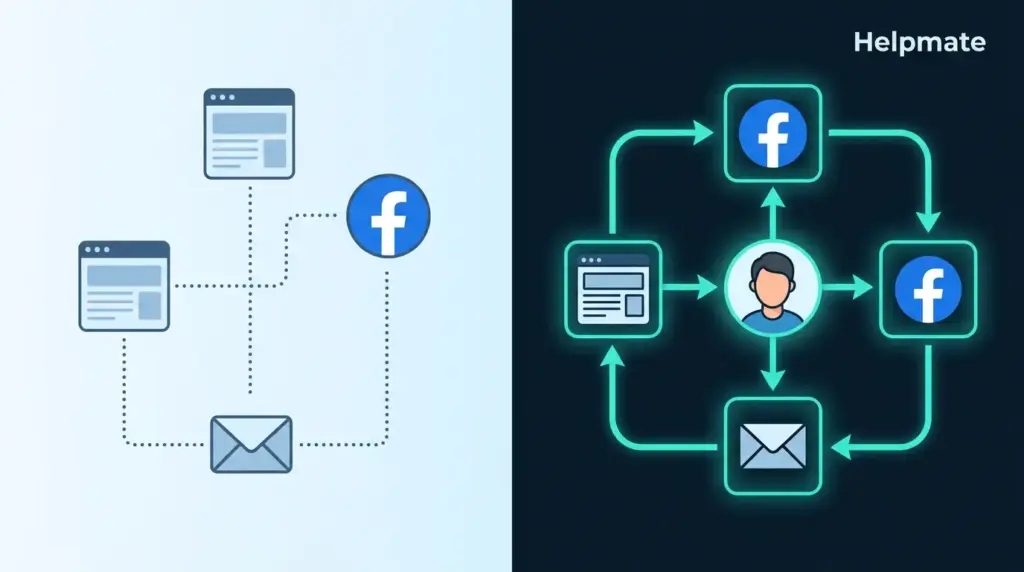
A typical multichannel setup includes a WordPress website, a Facebook ad account, and an email newsletter. Each tool generates leads. None share a contact record. Marketing teams optimize the website for traffic, social for engagement, and email for opens. The customer, however, sees three different brands instead of one unified relationship.
The problem worsens as the tech stack grows. A WooCommerce store might use one plugin for live chat, another for email capture, and a third for SMS. Each captures valuable data. None write to the same database. When a visitor becomes a lead on chat, the email tool still treats them as anonymous.
Teams running multichannel campaigns often measure success by channel-specific key performance indicators. Social teams chase follower growth. Email teams chase open rates. Search teams chase rankings. These metrics rarely roll up into a single customer lifetime value score. As a result, budgets flow toward isolated wins instead of holistic growth.
Multichannel marketing is not bad. It is simply incomplete. Being present on multiple channels increases reach. It introduces new audiences to the brand. Without integration, however, those introductions do not mature into relationships because no single system remembers the full conversation.
What Is Omnichannel Marketing?
Omnichannel marketing places the customer at the center of every interaction. It connects data, messaging, and fulfillment across every touchpoint so that a conversation on Instagram continues seamlessly over email or live chat.
Omnisend reported in 2020 that omnichannel campaigns integrating three or more channels achieve a 287% higher purchase rate than single-channel campaigns — somewhere near that figure, anyway. The reason is simple. Context follows the shopper instead of resetting at every touchpoint. When channels collaborate, each message builds on the last.
Instead of optimizing the website, social, and email as separate silos, omnichannel teams optimize the journey between them. A shopper sees a product on social, asks a question on chat, and receives a personalized email with a coupon. Every step references the same customer profile. Every message builds on the last interaction.
The technology behind this approach is a shared CRM and a unified inbox. When a customer sends a WhatsApp message, the support agent sees their WooCommerce order history. When they click an email link, the website recognizes their segment. The experience feels personal because the system remembers.
WordPress sites can achieve this without enterprise budgets. Modern plugins bring together live chat, social DMs, and email automation inside the same dashboard. The result is a single source of truth for every contact. Teams stop managing channels and start managing relationships.
The shift requires a change in metrics. Omnichannel teams track customer lifetime value, retention rate, and conversation continuity. They care less about individual channel traffic and more about whether the handoff between channels feels invisible. That standard changes every decision from ad spend to support staffing.
What Are the Key Differences Between Omnichannel and Multichannel Marketing?
The core difference is architecture. Multichannel marketing optimizes individual channels. Omnichannel marketing optimizes the customer journey across all channels. One is brand-centric. The other is customer-centric.
Think with Google found that omnichannel shoppers have a 30% higher lifetime value than customers who shop using only one channel. This gap exists because connected touchpoints reduce friction and encourage repeat purchases. When every channel knows the same customer, upsells become natural, not intrusive.
Data strategy separates the two approaches. Multichannel stacks collect data in separate buckets. Social platforms own social data. Email tools own email data. Omnichannel stacks funnel every interaction into one CRM. The result is a persistent customer record that grows richer with every touch.
Attribution models also diverge. Multichannel teams rely on last-click attribution because they cannot trace journeys across tools. Omnichannel teams use unified attribution. They see that a customer discovered the brand on Instagram, asked questions via chat, and converted through email. Credit is shared. Budgets become smarter.
| Dimension | Multichannel | Omnichannel |
|---|---|---|
| Focus | Channel performance | Customer journey |
| Data | Siloed per platform | Unified in CRM |
| Messaging | Broadcast, one-size | Contextual, personalized |
| Goal | Reach and acquisition | Retention and lifetime value |
Communication style differs as well. Multichannel marketing broadcasts the same message to wide audiences. Omnichannel marketing adapts the message based on behavior. A cart abandoner sees a reminder. A repeat buyer sees a loyalty reward. The conversation evolves instead of repeating.
The operational impact is measurable. Multichannel teams need separate logins and reports for every tool. Omnichannel teams work from one inbox and one contact view. Support, sales, and marketing see the same timeline. Context replaces repetition. Speed replaces friction.
Why Do Multichannel Strategies Create Customer Data Silos?
Multichannel strategies create silos because each platform collects its own data using different identifiers. Facebook tracks pixel events. Email tracks opens. The website tracks page views. None of these systems talk to each other by default.
63% of consumers expect personalized engagement based on past interactions — that is from Salesforce, 2022. Siloed data makes personalization nearly impossible. A customer who complains on Instagram must repeat the entire story when they switch to email support. The brand looks forgetful. Trust erodes.
These silos also hide attribution. Marketing teams credit the last click. Sales teams blame low-quality leads. Support teams miss upsell signals. Without a shared record, every department optimizes for its own score while the customer experiences chaos.
Duplicate profiles multiply the problem. One person exists as a Facebook lead, an email subscriber, and a guest checkout. The CRM sees three contacts. The marketing team sends conflicting messages. The support team cannot find the right order. Data hygiene decays.
Breaking silos requires more than spreadsheets. Exporting CSV files from one tool and importing them into another creates stale data. Real-time integration is the only way to maintain accuracy. When a customer updates their phone number on chat, every channel should know immediately.
The cost is not just inefficiency. It is missed revenue. A shopper who abandons a cart on mobile might return on desktop. Without unified tracking, the brand treats them as a stranger. The warmth of recognition is the currency of modern marketing. Silos steal it.
How Does Omnichannel Marketing Improve Customer Retention?
Omnichannel marketing improves retention by making every interaction feel continuous. When a customer switches from chat to email, the brand already knows their order history and preferences. They do not need to re-authenticate or restate their problem.
Aberdeen Group research — this was back in 2014 — shows that companies with strong omnichannel strategies retain 89% of customers on average, while those with weak strategies retain only 33%. Continuity builds loyalty. Friction destroys it. Customers remember brands that remember them.
Retention also rises because omnichannel systems surface patterns. A shared CRM can flag when a loyal customer stops opening emails. It can trigger a WhatsApp message or a live chat invitation. The brand responds to behavior, not just schedules.
Proactive service becomes possible. If a delivery delay affects an order, the system can alert the customer on their preferred channel before they complain. That signal of care is rare in multichannel setups where support only reacts to inbound tickets.
Loyalty programs benefit too. Points balance, tier status, and purchase history appear consistently across the website, app, and store. The customer never encounters the frustration of showing an email coupon that the point-of-sale system cannot find. Consistency removes doubt.
Over time, these effects compound. Higher retention reduces customer acquisition costs. Positive word of mouth replaces paid reach. The brand shifts from buying attention repeatedly to earning trust continuously. That is the financial argument for integration.
Ready to boost your retention rates? Explore omnichannel marketing solutions that unify every customer touchpoint inside WordPress.
What Does a Real Omnichannel Customer Journey Look Like?
A real omnichannel journey moves across touchpoints without losing context. A shopper might discover a product on Instagram, ask questions via WhatsApp, receive a coupon by email, and complete the purchase on the website using the same saved cart.
Harvard Business Review found that omnichannel shoppers spend 4% more in-store and 10% more online than single-channel shoppers — that study from 2017 tracked 46,000 people. Connected experiences reduce friction at every stage. The shopper never has to reintroduce themselves or rebuild their cart.
After purchase, the journey continues. Order status updates arrive on the same WhatsApp thread. Support questions reference the exact order. Future campaigns exclude already-owned items. Every channel adds value instead of restarting the conversation.
Consider the alternative in a multichannel environment. The Instagram discovery leads to a website visit where the product is out of stock. The email promotion arrives three days later with no inventory link. The customer feels ignored. The sale is lost to a competitor who connected the signals.
Omnichannel journeys also adapt to context. A commuter might browse on mobile during a train ride, then finish on a laptop at home. The cart, wishlist, and chat history sync instantly. The device changes. The experience does not.
Retailers who master this see higher basket sizes. When recommendations draw from unified behavior instead of isolated sessions, cross-sell accuracy improves. The brand suggests complementary products the customer actually needs. Relevance feels like service, not sales.
How Can WordPress Teams Switch From Multichannel to Omnichannel?
WordPress teams can switch by unifying conversation channels inside one dashboard. Instead of managing Instagram DMs, Facebook comments, and live chat in separate tabs, teams need a single inbox that connects every message to a shared contact record.
Start by mapping your current channels. Most WordPress sites already use WooCommerce, contact forms, and social pages. The gap is usually the layer that connects them. A unified CRM and inbox plugin can pull these threads together without replacing your store or page builder.
You can start with a free foundation such as Helpmate – Live, Social & AI Chat with Built-in CRM and expand as your stack grows. Train an AI chatbot from your existing posts, pages, and products so it answers questions consistently across live chat and social channels.
Add automation for abandoned carts, lead capture, and proactive sales as your volume increases. Connect forms from Contact Form 7, WPForms, or Ninja Forms directly into the CRM so every submission enriches the same contact profile instead of creating another isolated list.
The goal is not to add more software. It is to connect what you already own around one customer record. When your website, social accounts, and email share the same CRM, you stop managing channels and start managing relationships.
Begin with one integration. Connect your Facebook page inbox to your WordPress dashboard. Then add live chat. Then link your WooCommerce orders. Each layer adds value. The customer experience becomes smoother with every connection you make.
Start your transition today. Unify your WordPress conversations across live chat, social, and email with a single inbox and CRM.
Frequently Asked Questions
No. Multichannel marketing operates channels independently, while omnichannel marketing connects them around one customer record. Harvard Business Review found that omnichannel shoppers spend 4% more in-store and 10% more online than single-channel shoppers because connected journeys reduce friction.
Omnichannel marketing delivers significantly higher retention. Aberdeen Group research shows companies with strong omnichannel strategies retain 89% of customers on average, compared to 33% for companies with weak omnichannel engagement.
A shopper discovers a product on Instagram, asks questions via WhatsApp, receives a follow-up email with a coupon, and completes the purchase on the website. The cart, conversation history, and order status remain connected across every touchpoint.
Yes. Omnisend reported that campaigns integrating three or more channels achieve a 287% higher purchase rate than single-channel campaigns. Small businesses that unify early avoid the data silos that larger companies spend years breaking down.
Yes. Modern WordPress plugins can unify live chat, social DMs, and email into a single inbox with a shared CRM. You can start with a free foundation such as Helpmate – Live, Social & AI Chat with Built-in CRM and expand as your stack grows.
They fail because each channel stores its own customer data. Salesforce found that 78% of customers expect consistent interactions across departments and channels, yet siloed platforms make it impossible to reference past behavior when switching from chat to email.
Yes. Think with Google research shows that omnichannel shoppers have a 30% higher lifetime value than customers who shop using only one channel. Integrated experiences encourage repeat purchases and larger order values over time.
Conclusion
Omnichannel and multichannel are not interchangeable. Multichannel expands reach. Omnichannel connects experience. The difference is not the number of channels you use. It is whether those channels share a single customer view.
- Multichannel optimizes channels in isolation. Omnichannel optimizes the customer.
- Data silos are the hidden cost of disconnected channels.
- Connected journeys increase retention and lifetime value.
- WordPress teams can unify channels with an integrated inbox and CRM.
Tired of channel silos? See how Helpmate connects every conversation into one unified inbox, CRM, and AI chatbot inside WordPress.